Category: Travel Guide

KOREA travel-guide

  • Best Day Trips from Seoul — Hidden Gems Within 2 Hours

    Best day trips from Seoul — scenic Korean countryside with temples and mountains within 2 hours

    The best day trips from Seoul — hidden gems within 2 hours — are honestly some of the most rewarding experiences this country has to offer, and after more than a decade of living here, I still find myself genuinely excited every single time I step off a train into one of these places. Seoul is magnificent, don’t get me wrong, but Korea’s real soul lives just beyond the city limits — in fortress walls draped in morning mist, coastal towns where raw seafood arrives at your table still moving, and pottery villages so quiet you can hear the wind cut through the pine trees. The best part? You don’t need a tour group, a rental car, or a complicated itinerary. Korea’s rail and bus network is so well-connected that most of these hidden gems are a single, affordable ticket away.

    What I love most about these Seoul day trips is how dramatically different each destination feels from the capital. You can leave Gangnam at 8am, arrive at a UNESCO-listed fortress by 10am, eat a legendary local lunch for under ₩15,000 (~$11), and be back on your rooftop bar stool in Hongdae by 7pm. That kind of range — from ancient history to coastal seafood to misty mountain trails — within two hours of one of Asia’s largest cities is genuinely rare anywhere in the world. Let me walk you through the three destinations that I personally keep recommending to every traveler who asks me where to go when they’ve already ticked off Gyeongbokgung and Bukchon.

    25+
    Day Trip Destinations Within 2 Hours
    1794
    Year Suwon Hwaseong Was Built
    5.7km
    Length of Hwaseong Fortress Wall
    90min
    Seoul to Gapyeong by ITX Train

    Suwon Hwaseong — A UNESCO Fortress Most Tourists Completely Miss

    Suwon is probably the most underrated day trip from Seoul in all of Korea, and I say that as someone who has taken at least thirty friends and family members there over the years. The city sits just 30 kilometers south of Seoul — Line 1 direct from Seoul Station, about 50 minutes, ₩2,800 (~$2.10) — and at its heart is Hwaseong Fortress, a perfectly preserved 18th-century fortification that wraps 5.7 kilometers around a hillside in a way that simply takes your breath away. Built in 1794 by King Jeongjo of the Joseon Dynasty, the fortress earned its UNESCO World Heritage status not just for its age but for its remarkably innovative engineering — watchtowers, command posts, and floodgates that were revolutionary for the era. Enter from Paldalmun Gate (the south gate, right next to Suwon Station Exit 2), pay the ₩1,000 (~$0.75) entry fee — yes, that’s correct, less than a dollar — and start walking the walls counterclockwise. The locals almost always go clockwise, so you’ll have the northern stretch largely to yourself, especially before 10am. At the top of Paldalsan hill, stop at Seojangdae command post and look north — on a clear day, you can see Seoul’s skyline shimmering in the distance, which is one of those Korea moments that genuinely stops time.

    After the walls, walk five minutes downhill into Haenggung Palace — King Jeongjo’s temporary palace, entry ₩1,500 (~$1.10) — and then reward yourself in the alley just outside the east gate with Suwon galbi. This city is the spiritual home of galbi (grilled beef short ribs) in Korea, and the restaurants clustered around Yeongdong Market have been perfecting the same marinade recipe for generations. A full galbi meal for two lands around ₩40,000–₩60,000 (~$30–$45), which is mid-range by Seoul standards but absolutely exceptional in quality. The secret the locals know: order the “왕갈비” (king galbi) — the larger-cut ribs — and ask for extra ssamjang on the side.

    💡 Insider Pro Tip

    Take the free Hwaseong Trolley (화성어차) that loops the fortress perimeter — it runs every 20–30 minutes from 9am and costs ₩4,000 (~$3) for the full circuit. Locals use it as a lazy Sunday ride, not a tourist attraction, so it’s rarely crowded on weekday mornings. It drops you right at Hwahongmun floodgate, which is the single most photogenic spot in all of Suwon — red lacquered archways reflected in the water below. Go before 9:30am when the light is still soft and the tour groups haven’t arrived.

    Gapyeong & Nami Island — Where Korea Goes to Exhale

    Most people have heard of Nami Island through the Korean drama “Winter Sonata,” but what most travelers don’t realize is that the real magic of this day trip from Seoul lies not on the island itself but in the entire Gapyeong valley that surrounds it. Take the ITX-Cheongchun train from Yongsan
  • Best Day Trips from Seoul — Hidden Gems Within 2 Hours

    Scenic Korean countryside train journey — best day trips from Seoul hidden gems within 2 hours

    If you are searching for the best day trips from Seoul — hidden gems within 2 hours, you have landed in exactly the right place, because after twelve years of living here and riding what feels like every train line out of the city, I can tell you with complete confidence that the landscapes and towns sitting just beyond Seoul’s traffic are some of the most underrated travel experiences in all of East Asia. Most visitors spend their entire trip inside the Han River corridor, cycling Yeouido or lining up for bibimbap in Insadong, and I completely understand the pull — Seoul is electric. But the moment you let a KTX or an ITX-Cheongchun train pull you north, east, or south, Korea starts revealing a quieter, stranger, more beautiful version of itself that the Instagram algorithm has barely touched yet.

    What makes these hidden gem day trips so satisfying is the sheer variety packed into such a compact radius. You can go from Seoul Station’s gleaming concourse to a 1,000-year-old fortress wall, a fog-draped lakeside railway village, or a tidal-flat seafood town — and still be back in Hongdae for a late craft beer. Korea’s train infrastructure genuinely spoils you rotten, and once you learn how to use it like a local, the city starts feeling less like a destination and more like the comfortable home base it already is for the 10 million people who live here. These are the escapes I recommend to every friend who visits me, and I’m giving you the exact routes, prices, and street-level details I wish I had on my very first trip.

    4
    Hidden Gem Destinations
    120km
    Max Distance from Seoul
    936
    AD — Oldest Site Featured
    ₩15K
    Avg One-Way Train Fare (~$11)

    Gapyeong & Nami Island — The Romantic Railway Village Everyone Gets Wrong

    Nami Island (남이섬) is famous — I know, I know — but the way most tourists approach it is almost comically inefficient, and there is a hidden layer to this whole area that day-trippers almost never find. From Cheongnyangni Station in eastern Seoul, the ITX-Cheongchun train reaches Gapyeong Station in about 80 minutes for roughly ₩4,800 (~$3.60), and this ride alone — threading between granite ridges and the North Han River — is worth the fare. The classic mistake is rushing straight to Nami’s ferry (₩16,000 round-trip, ~$12, including island admission) and leaving. Instead, get off at Gapyeong, grab a steaming bowl of 닭갈비 (spicy stir-fried chicken) at one of the pojangmacha stalls right outside Exit 1 for about ₩9,000 (~$6.80), and then arrange a visit to Jaraseom Jazz Island and Petite France — all accessible by a single local shuttle bus that departs the station forecourt every 30 minutes. The detail almost nobody tells you: if you take the very first ITX out of Cheongnyangni at 06:19, you arrive at Nami Island before the cruise-ship tour groups dock, and the famous metasequoia tree avenue is completely, hauntingly empty. That one hour of solitude among those towering trees is genuinely one of my favorite experiences in all of Korea.

    Gongju & Buyeo — Baekje Kingdom Ruins That Feel Like a Secret

    If you want to talk about truly hidden gems near Seoul, Gongju and Buyeo in South Chungcheong Province are the ones that make me emotional, because these two small cities hold the magnificent, UNESCO-listed ruins of the Baekje Kingdom (18 BC–660 AD) and almost no international visitors ever make the trip. From Seoul’s Yongsan Station or Seoul Station, the KTX reaches Gongju in about 50 minutes for ₩22,800 (~$17), and from there it’s a ₩10,000 (~$7.50) taxi ride to Gongsanseong Fortress, a sinuous stone wall that coils over green hills above the Geum River. Admission is ₩3,000 (~$2.30) and the walk along the battlements at golden hour, with a river bending silver below you, is the kind of thing that makes you cancel your flight home. After Gongsanseong, take a local bus (Bus 106, about ₩1,500/~$1.10) 30 minutes south to Buyeo, where the Baekje Cultural Land complex and the hauntingly beautiful Jeongnimsaji Five-Story Stone Pagoda — standing alone in a field since 634 AD — will rewire your sense of Korean history entirely. The insider secret here is the Gung-nam Pond and pavilion at dusk, which local couples and grandmothers with folding chairs use as a private sunset spot. Admission to the full complex is ₩9,000 (~$6.80) and covers more ground than most people budget time for, so I strongly suggest leaving Seoul on the 08:00 KTX and committing the full day.

    💡 Insider Pro Tip

    For Gongju and Buyeo, buy a Kor

  • Gyeongju Travel Guide — Korea’s Ancient Capital and UNESCO Heritage Sites

    Bulguksa Temple surrounded by autumn foliage in Gyeongju, Korea's ancient capital

    If you’ve been searching for a destination that genuinely stops you in your tracks, this Gyeongju Travel Guide — Korea’s Ancient Capital and UNESCO Heritage Sites is the one you need to bookmark right now, because no other city in Korea makes you feel the weight of a thousand years of history the way Gyeongju does. I still remember the first time I stepped off the KTX at Singyeongju Station and drove into the city as golden-hour light fell across the Daereungwon royal burial mounds — those enormous grass-covered tombs rising silently from the middle of a modern neighborhood — and I genuinely had to pull over just to take it in. This city was the capital of the Silla Kingdom for nearly a millennium, from 57 BC to 935 AD, and every single corner of it holds something that was buried, carved, or built during that era. Seoul is electrifying, Busan is exhilarating, but Gyeongju? Gyeongju is quietly, stubbornly magnificent.

    What makes Gyeongju unlike any other stop on the Korean travel circuit is that the UNESCO heritage sites here aren’t roped off inside a single museum compound — they’re woven into the fabric of the city itself. You can be eating a bowl of 쌀밥 (rice) at a tiny restaurant and look out the window at a Silla-era stone pagoda standing thirty meters away. You’ll cycle past ancient tumuli on a rented bike, wander into temple courtyards that have been continuously used for over 1,300 years, and watch the moon rise over a stone observatory that predates most of European medieval architecture. Two days here is the absolute minimum; three days is where the magic really begins to settle in.

    57 BC
    Silla Kingdom Founded
    5
    UNESCO World Heritage Zones
    1,000+
    Years as Korea’s Capital
    ~2HR
    From Seoul by KTX

    Getting to Gyeongju and Settling In

    The fastest way from Seoul is the KTX to Singyeongju Station (신경주역), which takes about 2 hours and costs around ₩43,000–₩59,000 (~$32–$44) depending on the seat class and booking timing. Here’s the local knowledge most travel blogs miss: Singyeongju Station is actually located in Eonyang, about 12 km outside the city center, so you’ll need to hop on Bus 700 or 60 right outside the station exit (look for the stop immediately to your left as you leave) to reach downtown Gyeongju in another 25–30 minutes for just ₩1,500 (~$1.10). Alternatively, if you’re coming from Busan, the regular Mugunghwa line train from Bujeon Station drops you directly at Gyeongju Station right in the heart of the city — that’s actually my preferred approach when I’m traveling light, because the old station building itself has this wonderful faded-glory charm. For accommodation, I’d strongly recommend staying in or near the Hwangnam-dong neighborhood, which puts the Daereungwon tumuli park literally a five-minute walk from your front door. Budget guesthouses like Gyeongju Hanok Village stay start from around ₩40,000 (~$30) a night, and a comfortable mid-range hotel near Bomun Lake runs ₩100,000–₩160,000 (~$75–$120).

    The UNESCO Sites You Absolutely Cannot Miss

    Gyeongju’s UNESCO World Heritage status covers the entire “Gyeongju Historic Areas” designation — five distinct zones packed with royal tombs, Buddhist temples, stone carvings, and palace ruins. Start your first morning at Bulguksa Temple (불국사), one of the crown jewels of Korean Buddhist architecture and easily the most visited heritage site in Gyeongju. The entry fee is ₩6,000 (~$4.50) for adults, and it takes about 25–30 minutes by bus from downtown (Bus 10 or 11 from Gyeongju Bus Terminal). Get there before 9 AM — I can’t stress this enough — because by 10 AM tour groups arrive in waves, and what should feel like a profound spiritual space starts feeling like rush hour. The two stone pagodas in the main courtyard, Dabotap and Seokgatap, have stood here since 751 AD and they are genuinely breathtaking; notice how Dabotap’s intricate multi-tiered design appears on the back of the Korean 10-won coin. From Bulguksa, it’s just a 15-minute ride up the mountain to Seokguram Grotto (석굴암), where a stunning granite Buddha statue sits in an artificial stone cave gazing out over the East Sea — on a clear day you can actually see the ocean from the hillside path. Entry is ₩6,000 (~$4.50) separately, and the grotto path is most magical in early morning mist. Back in the city center, don’t skip Cheomseongdae (첨성대), a 9th-century stone astronomical observatory that looks deceptively simple but is astronomically precise — it’s free to visit from the outside and sits in an open park near Wolseong. Right next to it, the Daereungwon Tumuli Park (대릉원) houses 23 royal Silla burial mounds spread across

  • Best Cafes in Seoul — A Neighborhood-by-Neighborhood Guide

    Best cafes in Seoul — a neighborhood-by-neighborhood guide showing a beautifully designed Korean cafe interior with latte art

    If you’ve ever wanted the definitive Best Cafes in Seoul — A Neighborhood-by-Neighborhood Guide, you’re in exactly the right place, because I’ve spent over a decade caffeinating my way through every alley, rooftop, and repurposed hanok in this city. Seoul’s café culture isn’t just about coffee — it is a full sensory experience where the architecture competes with the latte art, the plating rivals any fine-dining dessert spread, and the playlist feels personally curated for your mood. Koreans take their café spaces extraordinarily seriously, and once you understand that, every neighborhood suddenly reads like its own coffee chapter.

    What I love most about Seoul’s café scene is how radically different it feels from one neighborhood to the next. The brooding, concrete-heavy specialty coffee shops of Seongsu-dong feel like a completely different universe from the pastel-drenched dessert cafés of Yeonnam-dong, which feel nothing like the hushed, centuries-old hanok teahouses tucked into Bukchon’s stone-walled lanes. This guide won’t just hand you a list — I’m going to walk you through the personality of each neighborhood so you can find your own Seoul café story, the way I found mine.

    17,000+
    Registered cafés in Seoul
    ₩6,000
    Avg. specialty latte (~$4.50)
    605km²
    Area of Seoul city proper
    2000s
    Decade café culture exploded

    Seongsu-dong & Hapjeong: Seoul’s Specialty Coffee Heartland

    If you want to understand where Seoul’s café scene is setting the global pace right now, get yourself to Seongsu-dong — Line 2, Exit 3 — and just start walking. This former industrial leather district has been quietly transforming since around 2015, and today its raw brick walls and exposed steel beams house some of the most technically rigorous specialty coffee operations in Asia. Café Onion (카페 어니언) in a converted 1970s factory is probably the most Instagrammed interior in all of Seoul, but don’t let the queues fool you — the croissants and rice lattes (₩7,000, ~$5.25) are genuinely excellent. The insider move here is to arrive at 8am on a weekday when the light pours through the cracked concrete ceiling and the line hasn’t formed yet. Across the Han River in Hapjeong, Fritz Coffee Company (프릳츠 커피 컴퍼니) on Line 6, Exit 3 is where Seoul’s barista community actually drinks on their days off — the house blend is roasted in-house, and the bear-shaped logo on your paper cup has become something of a cult symbol. Their single-origin pour-overs start at ₩8,500 (~$6.40), and the apple cinnamon scone sells out before 10am, so you’ve been warned.

    Yeonnam-dong, Mangwon & Hongdae: Where Character Cafés Are Born

    Pull up Line 2 to Hongik University Station (홍대입구역) and walk north into Yeonnam-dong — this is arguably Seoul’s most walkable café neighborhood, and the one I personally return to most. The former railway greenway called Gyeongui Line Forest Park cuts right through it, and on both sides you’ll find cafés that feel like living room art installations. Thanks Nature Café is famous for having a live sheep grazing on the roof garden — yes, really — and while it’s quirky, it represents something genuine about Yeonnam’s playful spirit. For serious coffee, though, Café Bora (카페 보라) in nearby Insadong started the purple-tinted boba and soft-serve trend that swept Instagram in 2018; a black sesame latte runs ₩6,500 (~$4.90). Just down the road in Mangwon, hit Line 6, Exit 2 and look for Café Mamas — a tiny all-day brunch spot where the owners grow herbs on the windowsill and the egg salad sandwich on thick milk bread costs only ₩5,500 (~$4.15). The neighborhood detail most tourists miss: Yeonnam’s best cafés are almost all on the side streets, not the main Donggyo-ro boulevard. Turn off that main road and you’ll discover entire café clusters that feel completely undiscovered.

    Bukchon, Insadong & Ikseon-dong: Tradition Steeped in Every Cup

    There is a particular kind of magic that happens when you drink a warm bowl of sikhye (sweet rice punch) inside a 600-year-old hanok while snow drifts past a paper-screen window, and you can find exactly that in Bukchon and the connected lanes of Ikseon-dong. Take Line 3 to Anguk Station, Exit 1, and walk uphill into the hanok village — the narrow alleys

  • Korean Night Markets — Where Locals Actually Eat

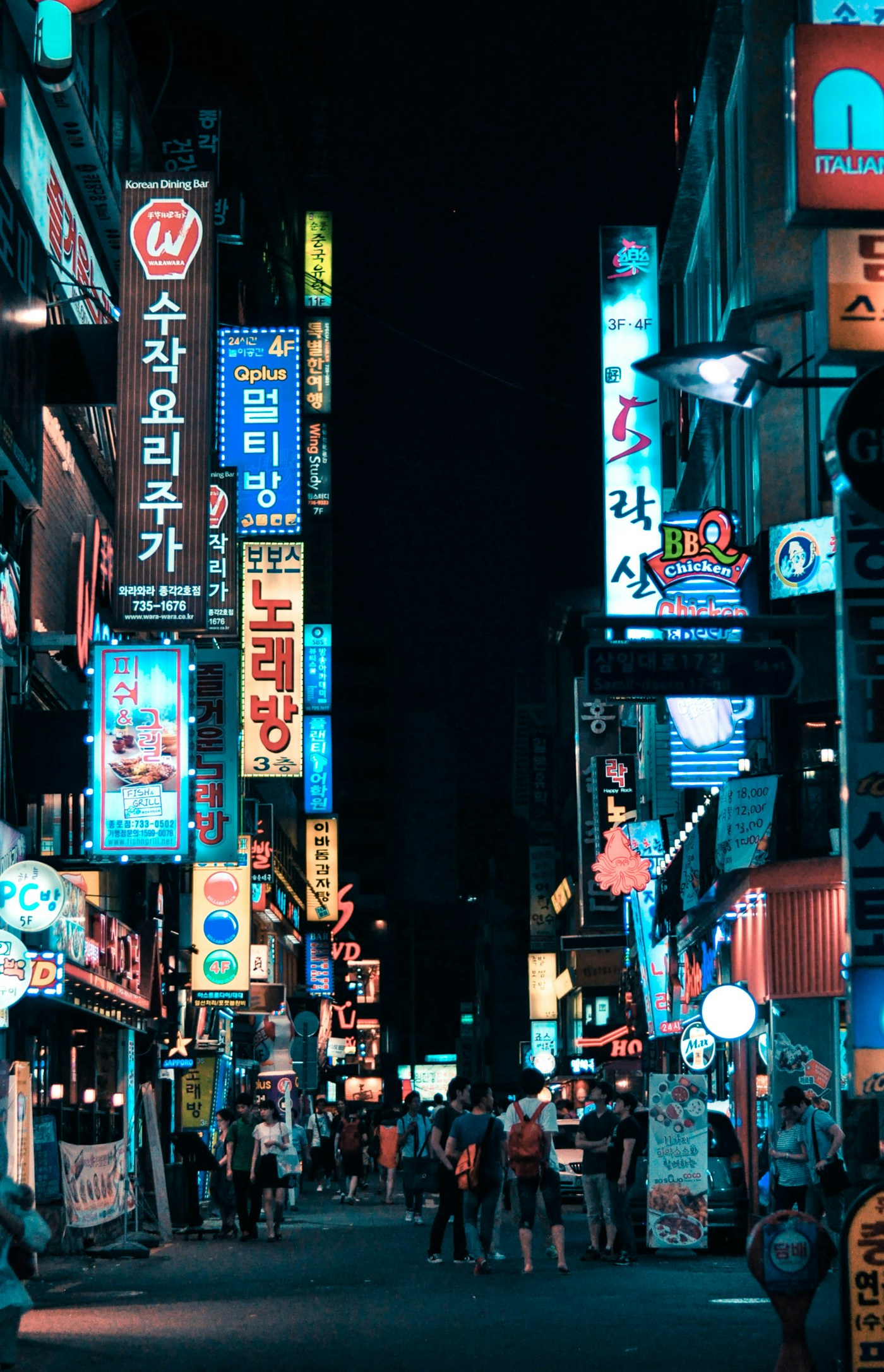
    Korean night market glowing with food stalls and crowds eating street food

    Korean Night Markets — Where Locals Actually Eat — are not the sanitized, tourist-polished food streets you see on Instagram reels. They are loud, smoky, impossibly fragrant places where office workers loosen their ties, grandmothers argue with vendors over tteok prices, and university students share a single plate of pajeon with four pairs of chopsticks. I have spent more evenings than I can count wandering these markets with nothing but ₩20,000 (~$15) in my pocket, and I have never once walked away hungry or disappointed. If you want to understand Korean food culture at its most honest and alive, this is exactly where you need to be after sundown.

    What makes Korean night markets so magnetic is that they function as the city’s living room. Nobody is performing for you. The ajeossi flipping dak-kkochi over charcoal has been doing it the same way for twenty years. The pojangmacha tent — that iconic orange-tarpaulin stall glowing like a lantern — doesn’t have a Naver Map listing or a QR code menu. It just has a handwritten sign, a gas burner, and food that will ruin you for restaurant versions forever. Whether you land in Seoul, Busan, Jeonju, or Incheon, the night market experience hits differently when you know which alleys to turn down and what to order without hesitating.

    9PM
    Peak local dining hour at most markets
    ₩2,000
    Avg street snack price (~$1.50 USD)
    1964
    Year Gwangjang Market officially opened
    65+
    Night markets active across Korea

    Seoul’s Best Night Markets — Beyond the Tourist Trail

    Most first-timers head straight to Myeongdong, and look — I get it. It’s central, it’s walkable, and the tteokbokki smells incredible from three blocks away. But honest truth? Myeongdong’s street food strip is priced for tourists, and the vendors know it. A single skewer of odeng (fish cake) there runs ₩3,000–₩4,000 (~$2.20–$3), whereas the same skewer at Noryangjin Market near Line 1, Exit 1 costs ₩1,000 (~$0.75) and tastes better because the broth has been simmering since morning. For the real Seoul night market experience, I always point people toward three places: Gwangjang Market (Line 1 or 5, Jongno 5-ga Station, Exit 8), Dongdaemun’s pojangmacha belt along Cheonggyecheon, and the underrated Mangwon Market in Mapo-gu (Line 6, Mangwon Station, Exit 1).

    Gwangjang Market deserves its own paragraph. It opened in 1905 — Korea’s first permanent market — and the second-floor mung bean pancake (bindaetteok) vendors have been frying in the same oil-black pans for generations. Sit at any of the low tables along the central aisle, order bindaetteok (₩4,000/~$3), mayak gimbap (tiny seaweed rolls, ₩3,000/~$2.20), and a bowl of yukhoe (raw beef) if you’re feeling bold (₩15,000/~$11), and just watch the chaos unfold around you. The insider move: go to the vendor booths on the inner north side of the market rather than the main entrance stalls — those are the ones that locals queue at, not the ones with the English signs out front.

    💡 Insider Pro Tip

    At Mangwon Market, arrive between 6PM and 7PM on a Friday evening and look for the halmoni (grandmother) selling hotteok stuffed with green onion and glass noodles instead of the usual sugar filling — it’s a savory version almost no tourist knows exists, and she typically sells out within 90 minutes. Her stall is on the left side of the main corridor, about 40 meters from the eastern entrance. Cash only, ₩1,500 (~$1.10) each.

    Busan and Jeonju — Where Regional Night Market Food Hits Hardest

    If Seoul night markets are the headline act, Busan’s Bupyeong Kkangtong Market (also called Bupyeong Kkulkkul Market, reachable via Line 1, Jagalchi Station, Exit 7) is the secret B-side that hardcore food people talk about in hushed, reverent tones. This market transforms completely after 6PM. The daytime produce vendors pack up and the night food stalls roll in — grilling dwaeji-gukbap sides, serving icy naengmyeon, and ladling out Busan’s famous milmyeon (wheat noodles in cold beef broth, ₩8,000/~$6) that you genuinely cannot find done this well anywhere in Seoul. The coastal air, the sound of the nearby Jagalchi fish market, the neon reflections on wet pavement — it is one

  • Bukchon Hanok Village — Seoul’s Most Beautiful Traditional Neighborhood

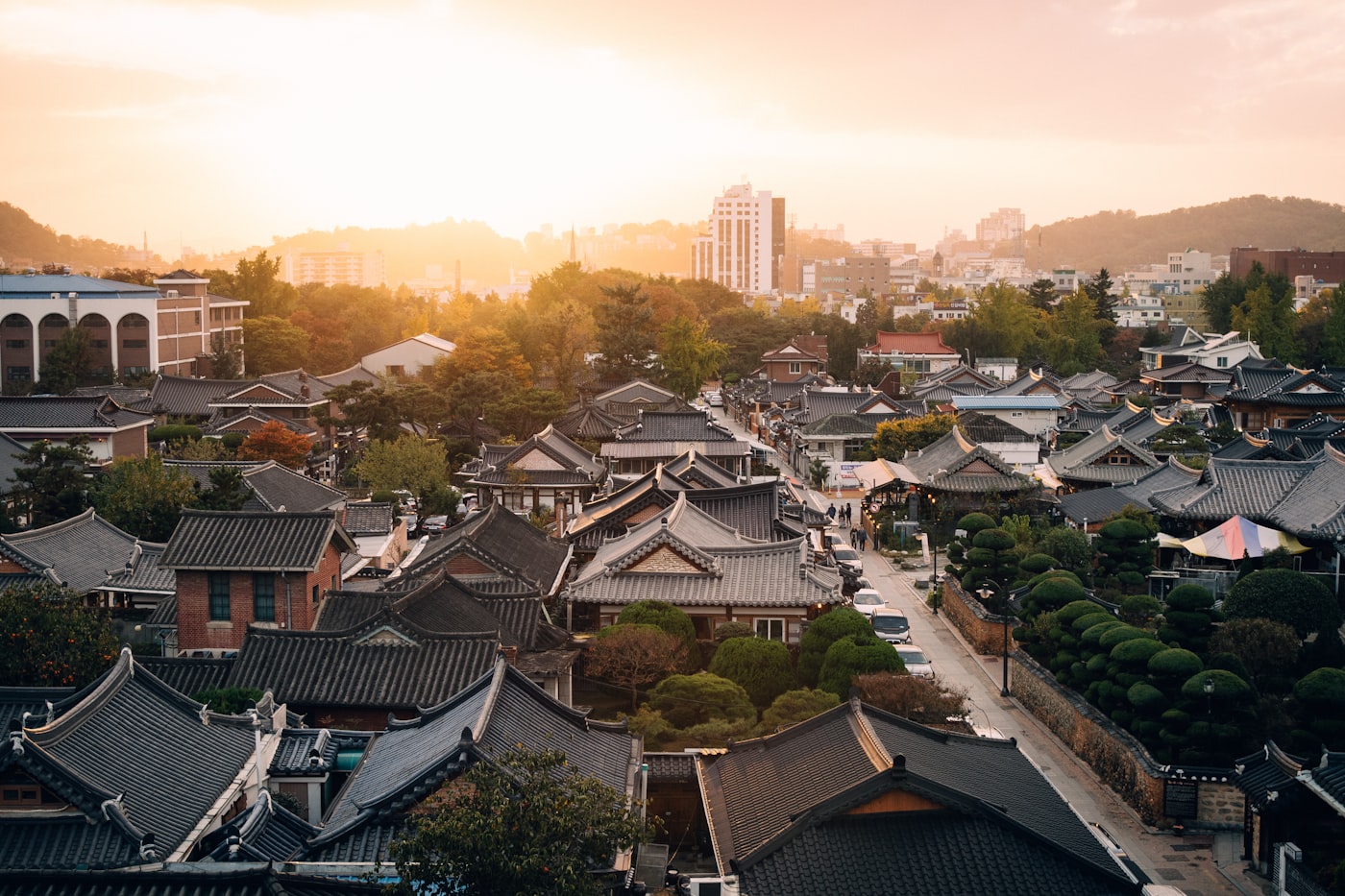
    Bukchon Hanok Village rooftops stretching across Seoul's traditional neighborhood at golden hour

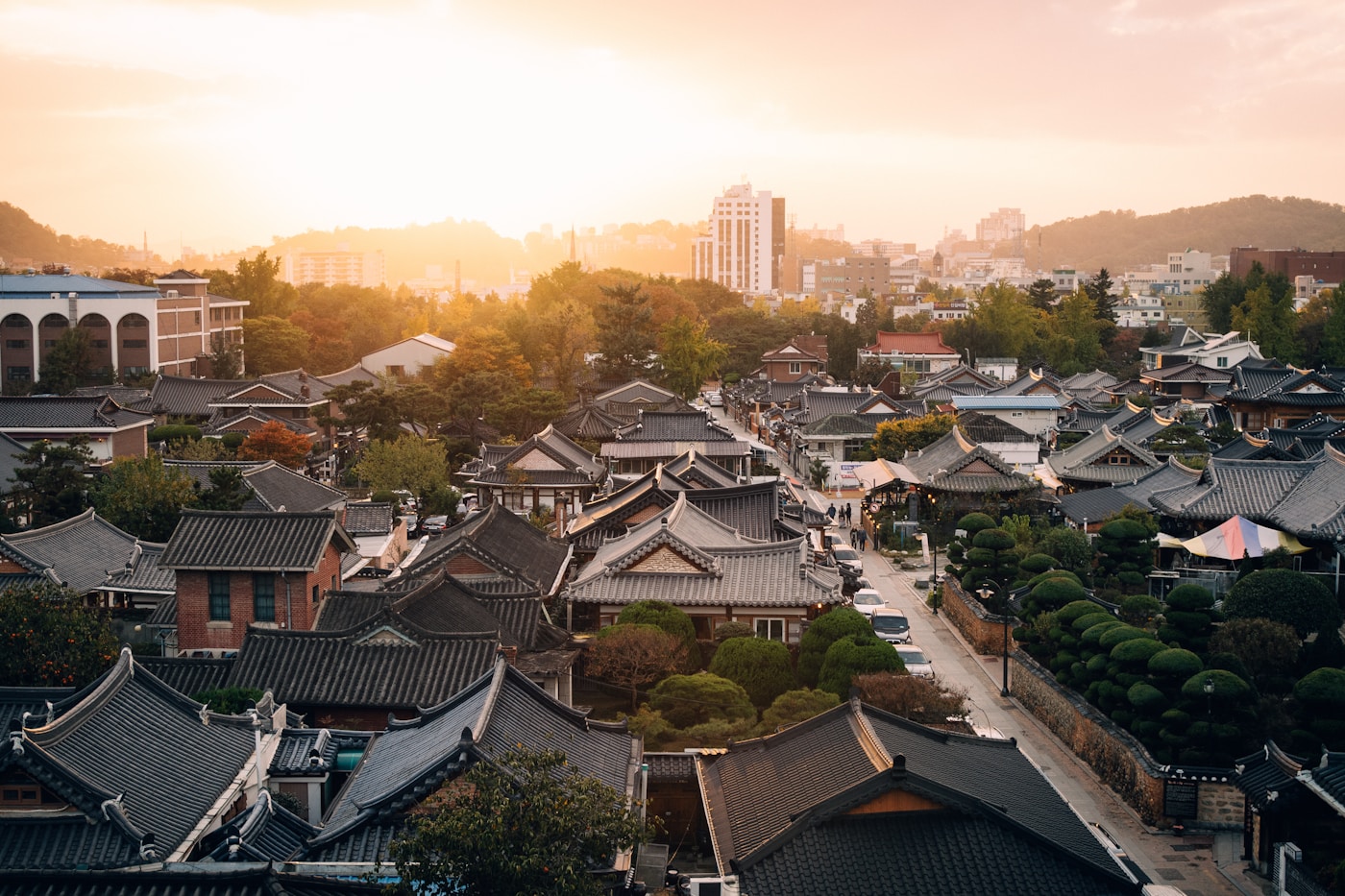
    Bukchon Hanok Village — Seoul’s Most Beautiful Traditional Neighborhood — hit me like a quiet thunderclap the first time I rounded the corner of Gahoe-dong and suddenly the entire modern city fell away, replaced by a sea of curved dark-grey tiled rooftops rolling down toward Gyeongbokgung Palace in the distance. After more than a decade of living in Seoul, that view still stops me cold every single time. This is not a reconstructed theme park or a prettied-up tourist set — real families have lived in many of these hanok for generations, and that lived-in humanity is exactly what makes Bukchon feel so different from anywhere else in this city of ten million people.

    Wedged between the grand palaces of Gyeongbokgung and Changdeokgung, with Inwangsan Mountain as its rugged northern backdrop, Bukchon occupies one of the most coveted plots of land in all of Korea. The neighborhood’s name literally means “North Village,” and for the Joseon Dynasty aristocracy — the yangban class — living here was the ultimate status symbol. Today, roughly 900 traditional hanok homes remain standing across the hillside lanes of Gahoe-dong, Samcheong-dong, and Wonseo-dong, making this one of the largest surviving clusters of traditional Korean architecture in an urban setting anywhere in the world. Walking these alleyways is not sightseeing — it is time travel with excellent coffee at the bottom of the hill.

    ~900
    Traditional Hanok Homes
    600+
    Years of History
    0.39
    Area in km²
    Free
    Village Entry

    How to Get There and When to Arrive

    Getting to Bukchon Hanok Village is refreshingly straightforward. Take Seoul Metro Line 3 (the Orange Line) to Anguk Station and use Exit 2 — you will emerge right at the southern gateway of the neighborhood, with Changdeokgung Palace to your left and the uphill lane toward Gahoe-dong stretching ahead of you. Alternatively, Line 3’s Gyeongbokgung Station (Exit 5) puts you at the western edge and makes for a beautiful approach walking east past the palace wall. The walk from Anguk Exit 2 to the famous “Bukchon 8 Gyeongjeom” — the eight scenic viewpoints signposted throughout the village — takes about 40 minutes at a relaxed stroll if you don’t stop, which you absolutely will.

    Timing your visit is everything here. I cannot stress this enough: arrive before 9:00 AM. The narrow lane at Gahoe-dong Alley No. 11, which is the most photographed street in the entire neighborhood — the one where the hanok rooftops cascade downhill with N Seoul Tower peeking above them in the distance — becomes genuinely shoulder-to-shoulder packed by 10:30 AM on weekends. Weekday mornings between 7:30 and 9:00 AM are magical; you’ll hear nothing but the wind, distant temple bells from Jogyesa, and the occasional resident shuffling to the corner store in slippers. Autumn (late October to mid-November) delivers fiery maple trees draped over the clay-tiled walls, while early March brings delicate plum blossoms to the inner courtyards — both seasons make Bukchon look almost painfully beautiful.

    💡 Insider Pro Tip

    The single best-kept secret in Bukchon is the rooftop view from the small public rest area just past Viewpoint No. 5 on Gahoe-dong. Most visitors snap their photo at the designated viewpoint sign and immediately turn back down. But if you continue uphill another 60 meters, there is an unlabeled stone bench terrace on the left that gives you a wider, completely unobstructed panorama of the hanok rooftops AND the Namsan Tower simultaneously — and almost nobody ever makes it up there. Go early, bring a coffee from the Café Onion Anguk branch just 200m south (open from 8:00 AM, Americano ₩5,500 / ~$4), and you will have one of Seoul’s great quiet moments entirely to yourself.

    What to See, Do, and Experience Inside the Village

    The core of Bukchon Hanok Village is best explored through the eight official scenic viewpoints, each numbered and marked with small signboards in Korean, English, and Chinese. Viewpoint No. 2 gives you the sweeping “postcard shot” of the descending alleyway — this is the one you’ve seen on every Korea tourism poster. But honestly, I find Viewpoints No. 6 and No. 7 far more rewarding; they sit higher on the hill in the quieter Wonseo-dong section, where the lanes are narrower, the walls are draped in climbing ivy, and you are deep enough into the residential core that you start seeing real domestic life — laundry hanging over courtyard walls, potted chrysanthemums lined up on doorsteps, elderly neighbors chatting on low wooden benches.

  • Gyeongju Travel Guide — Korea’s Ancient Capital and UNESCO Heritage Sites

    Bulguksa Temple in Gyeongju, Korea's ancient capital and UNESCO Heritage Site

    This complete Gyeongju Travel Guide — Korea’s Ancient Capital and UNESCO Heritage Sites — is the one article I wish someone had handed me the first time I stepped off the KTX at Singyeongju Station, slightly dazed and suddenly surrounded by burial mounds the size of apartment buildings rising quietly out of a residential neighborhood like the whole city had simply grown up around its dead kings. That image alone tells you everything about Gyeongju: history here isn’t locked behind museum glass — it breathes, it interrupts your walk to the convenience store, and on a clear autumn evening when the royal tumuli of Daereungwon glow amber under a low sun, it stops you cold and makes you genuinely grateful you came.

    Gyeongju served as the capital of the Silla Kingdom for nearly a thousand years — from 57 BC all the way to 935 AD — and the sheer density of what was left behind earned the entire city the nickname “the museum without walls.” UNESCO agreed, designating the Gyeongju Historic Areas as a World Heritage Site in 2000, covering five distinct cultural zones packed with royal tombs, Buddhist temples, stone pagodas, and fortress ruins. For anyone serious about understanding where Korean culture, Buddhist art, and East Asian civilization intersect, Gyeongju isn’t optional. It’s essential.

    57 BC
    Silla Kingdom Founded
    2000
    UNESCO World Heritage Year
    23
    Royal Tumuli in Daereungwon
    2hrs
    KTX from Seoul (Singyeongju)

    Getting to Gyeongju and Navigating Like a Local

    Here’s the thing that trips up almost every first-time visitor: there are two train stations and you absolutely need to know which one to use. Singyeongju Station is the KTX stop — it’s fast (about 2 hours from Seoul’s Suseo or Dongdaegu transfer, around ₩59,800 / ~$45 one way), but it drops you 20 minutes outside the city center by taxi or bus. Gyeongju Station, the older one right in the heart of the city near the tumuli park, is served by slower Mugunghwa trains from Seoul (about 4 hours, ~₩28,000 / ~$21) but puts you within walking distance of most historic sites. My honest advice: take the KTX to Singyeongju and grab Intercity Bus 700 or a taxi (~₩15,000 / ~$11) straight to your accommodation in the downtown core. You’ll save an hour each direction compared to the slow train and still land exactly where you need to be.

    Once you’re in Gyeongju, forget about a subway — this city runs on bicycles, city buses, and taxis. Renting a bike near Gyeongju Station (look for the rental shops along Taejong-ro, around ₩5,000–8,000 / ~$4–6 per hour) is genuinely the best way to connect the sites. The flat terrain around the tumuli zone and Cheomseongdae is perfect cycling territory, and you’ll cover ground that would take multiple bus rides in a single lazy morning. The local Bus 11 is your lifeline for reaching Bulguksa Temple and Seokguram Grotto, departing from the intercity bus terminal roughly every 30 minutes — the ride takes about 30 minutes and costs ₩1,400 / ~$1.

    The UNESCO Heritage Sites You Cannot Miss

    Bulguksa Temple is the crown jewel of Gyeongju’s ancient capital, and I say that having visited more Buddhist temples in Korea than I can honestly count. What sets Bulguksa apart isn’t just its age (construction began in 528 AD, with the current structures rebuilt after Japanese invasions) — it’s the architectural sophistication of its stone staircases and lotus bridges, which Silla craftsmen designed as a symbolic ascent from the earthly world to the Buddhist realm. Admission is ₩6,000 / ~$4.50 for adults. Get there before 9am on weekends; tour groups descend around 10am and the energy shifts entirely. The pine forest behind the main hall, which most visitors never enter, offers 20 minutes of quiet that feels almost sacred.

    A 3km uphill road from Bulguksa — Bus 12 covers it, or a tough but rewarding 40-minute walk through pine forest — leads to Seokguram Grotto, and I will tell you plainly: this is one of the most emotionally powerful things I have experienced in 12 years of living in Korea. The granite Buddha seated at the center of a domed stone chamber, gazing east toward the sea, was completed in 774 AD and remains a masterpiece of East Asian Buddhist sculpture. You cannot enter the chamber itself (a glass enclosure protects the interior from humidity), but the view through the glass, combined with the mountain air and ocean horizon beyond the trees, creates something genuinely moving. Entry is ₩6,000 / ~$4.50 and covered by a combined ticket with Bulguksa (₩10,000 / ~$7.50 combined — always buy the combo).

  • Bukchon Hanok Village — Seoul’s Most Beautiful Traditional Neighborhood

    Bukchon Hanok Village traditional Korean houses with tiled roofs and Seoul cityscape in background

    Bukchon Hanok Village — Seoul’s Most Beautiful Traditional Neighborhood — is one of those rare places that genuinely stops you mid-step, and I still get that catch in my chest every single time I walk up Gahoe-ro 11-gil on a crisp autumn morning, the curved black-tiled rooftops rippling down the hillside like a brushstroke painting come to life. Tucked between Gyeongbokgung Palace and Changdeokgung Palace in the heart of Jongno-gu, this living, breathing neighborhood has somehow held its ground against 600 years of history, Japanese colonial rule, rapid modernization, and the relentless march of Seoul’s skyline — and it remains, without question, the single most cinematic stretch of traditional Korean architecture you will find anywhere inside a major Asian capital city.

    What makes Bukchon genuinely different from other heritage districts across Asia is that real families still live here. These are not museum reconstructions or theme-park replicas — they are private homes, and the 900-plus hanok houses lining the steep alleyways have been continuously inhabited and maintained for generations. When the light turns golden around 5 p.m. in October and the scent of someone’s dinner drifts over a low earthen wall, you will understand immediately why this neighborhood makes every “most beautiful places in Korea” list ever written, and why it deserves every word of that praise.

    900+
    Traditional Hanok Houses
    600
    Years of History
    0.38
    km² Area
    10M+
    Annual Visitors

    How to Get There, When to Visit, and What to Expect

    Getting to Bukchon Hanok Village is genuinely easy — take Subway Line 3 (the orange line) to Anguk Station and use Exit 3. From the exit, you will walk about five minutes north up Bukchon-ro toward the main village entrance. Alternatively, Line 3 Gyeongbokgung Station (Exit 2) gives you a slightly longer but beautifully scenic approach past the palace walls. I personally prefer the Anguk approach because you pass a row of small traditional tea shops and independent bookstores on Insadong-gil before the neighborhood reveals itself gradually — and that slow reveal is part of the magic. Avoid taking a taxi directly into the lanes; the streets are absurdly narrow and drivers hate the detour.

    For timing, I will be honest with you: Bukchon is genuinely crowded on weekends between 10 a.m. and 4 p.m., especially in spring (late March through April, cherry blossoms) and autumn (mid-October through early November, golden foliage against the grey tile roofs). If you want that iconic, nearly empty alley photograph — the one with the long staircase of Gahoe-ro 11-gil — you need to be standing there no later than 7:30 a.m. on a weekday. I have done it dozens of times and the village at dawn, with soft mist rolling off Bugaksan mountain behind you and not another tourist in sight, is genuinely one of Seoul’s great quiet gifts.

    💡 Insider Pro Tip

    The eight official “Bukchon Scenic Points” are well-marked, but locals know that Scenic Point 2 — the mid-staircase viewpoint on Gahoe-ro 11-gil — is far more spectacular photographed from above, not below. Walk all the way to the top of the lane, turn around, and shoot back downhill with the Han River faintly visible on the horizon on clear winter days. Also: the tiny path that runs along the north wall of Changdeokgung Palace (Waryong Park trail) is almost never mentioned in guidebooks, yet it offers a rooftop-level view over the entire hanok sea that will absolutely wreck you with its beauty.

    What to Do, See, and Experience Inside the Village

    Walking is the entire point of Bukchon Hanok Village, and I mean that with complete sincerity — put your phone in your pocket for at least thirty minutes and simply wander. The official self-guided walking route covers eight scenic viewpoints and takes roughly ninety minutes at a relaxed pace. Start at Bukchon Traditional Culture Center on Gyedong-gil (free entry, open Tuesday–Sunday 9 a.m.–6 p.m.), where you can pick up a free Korean–English map and occasionally catch a free gayageum or pansori performance in the inner courtyard. These performances are not widely advertised — I stumbled onto my first one purely by accident — and sitting cross-legged on a wooden maru (elevated porch floor) listening to traditional music with hanok rooftops all around you is as close to time travel as Seoul offers.

    For hands-on cultural experiences, Bukchon has excellent options at very reasonable prices. Gahoe Minhwa Workshop on Gahoe-ro 11-gil offers minhwa (traditional folk painting) classes starting at ₩20,000 (~$15) per person, no reservation needed on week

  • Namsan Seoul Tower — Complete Visitor Guide

    Namsan Seoul Tower glowing at night above the city skyline

    This is your Namsan Seoul Tower — Complete Visitor Guide, and I want you to picture this for a moment: you step off the cable car, the cold mountain air hits your face, and suddenly the entire sprawl of Seoul — 10 million people, a thousand glittering apartment towers, the Han River cutting through it all like a silver ribbon — unfolds below you in every direction. That is the moment Namsan delivers every single time, and after more than a decade of living in this city, it still stops me in my tracks. N Seoul Tower, perched 479 meters above sea level on the forested slopes of Namsan Mountain, is not just a tourist landmark — it is the emotional center of the city, the place where locals come to confess love, where families celebrate, and where every first-time visitor to Korea understands for the first time just how enormous and magnificent Seoul truly is.

    What I love most about Namsan is that it rewards every type of traveler differently. Come at sunrise and you get the tower almost to yourself, mist rolling through the pine forests below, the city waking up in shades of peach and gold. Come at 9 p.m. on a Saturday and you get a totally different energy — couples pressing their palms against the love lock fences, street food vendors lighting up the plaza, the observatory deck alive with the click of cameras and the laughter of people seeing Seoul from above for the very first time. This guide will walk you through every layer of the Namsan experience so you arrive prepared, spend your money wisely, and leave with memories that will genuinely last.

    479m
    Altitude Above Sea Level
    1969
    Year Tower Was Built
    236m
    Tower Height Itself
    3M+
    Annual Visitors

    Getting to Namsan Tower — Cable Car, Bus, or Hike?

    The most atmospheric way to reach N Seoul Tower is via the Namsan Cable Car, and I will never stop recommending it. You board at the lower station near Myeongdong — take subway Line 4 to Myeongdong Station, Exit 3, walk about 10 minutes uphill past the street food stalls, and you will see the cable car terminal on your left. A round-trip cable car ticket costs ₩16,000 (about $12 USD) for adults, and one-way is ₩11,000 (~$8 USD). The ride itself is only about five minutes, but the view through the glass gondola as you rise above the pine-covered hillside is genuinely worth every won. That said, cable car lines during weekends and public holidays can stretch 45 to 60 minutes — I have been there. My honest local tip: if the cable car queue looks brutal, hop on the Namsan순환버스 (circular bus) — either Bus 02 from Chungmuro Station (Line 3 or 4, Exit 2) or Bus 03 from Dongguk University Station (Line 3, Exit 6). These small green shuttle buses run every 5–7 minutes and drop you almost at the tower base for just ₩1,500 (~$1.10 USD) with a T-money card. The buses are the real local secret and most tourists walk right past the stop without even noticing. If you are fit and the weather is cooperative, the hiking trails up Namsan are beautiful — the South Trail from Itaewon takes about 40 minutes and passes through a forest that feels impossibly peaceful given you are in the middle of a megacity.

    The Observatory, Love Locks, and Everything Inside N Seoul Tower

    Once you are at the top of Namsan Mountain, the tower plaza itself is free to wander — and honestly, on a clear day, this outdoor space alone is worth the journey. The famous love lock fences wrap around the base of the tower and hold tens of thousands of padlocks in every color imaginable, each one engraved or marked by a couple who came here together. Vendors near the plaza sell locks for around ₩5,000–₩10,000 (~$3.50–$7.50 USD) if you did not bring your own. The tradition started sometime in the early 2000s and has completely taken on a life of its own — on Valentine’s Day and Pepero Day (November 11), the plaza is absolutely packed. To go up inside the tower itself and access the observatory deck, adult tickets are ₩21,000 (~$15.50 USD) at the door, but you can save a few thousand won by booking online through the official N Seoul Tower website or on apps like Klook, which often run 10–15% discounts. The observatory sits at 243 meters combined height and offers 360-degree panoramic views through floor-to-ceiling windows. On an exceptionally clear winter day — and I mean a dry, cold, perfectly blue-sky day in January or February — you can actually see all the way to Incheon and the Yellow Sea. One insider detail most visitors miss: the digital telescope stations around the observatory deck let you zoom into specific neighborhoods like Gangnam, Bukchon, and even the palace grounds for free — spend time with these rather than rushing through. The tower also has a rotating restaurant called N Grill on the upper floor, where dinner sets start around ₩90,000–₩150,000 (~$66–$110 USD) per person — it is pricey, but the full 360-degree rotation takes about 48 minutes and the sunset timing makes it a genuinely special splurge for a special occasion.

  • Gyeongju Travel Guide — Korea’s Ancient Capital and UNESCO Heritage Sites

    Gyeongju Bulguksa Temple UNESCO Heritage Site Korea Ancient Capital

    If you only read one Gyeongju Travel Guide — Korea’s Ancient Capital and UNESCO Heritage Sites before you go, let it be this one, because I want to save you from treating this extraordinary city the way most first-timers do — rushing through in a single day and wondering why it felt flat. Gyeongju doesn’t reveal itself at a glance. It unfolds slowly, like a thousand-year-old scroll, and the moment you start paying attention to the green burial mounds rising out of residential neighborhoods, the carved stone faces half-hidden in forest trails, and the lotus ponds that glow copper at dusk, you’ll understand why Koreans call it “a museum without walls.” I’ve walked every corner of this city over dozens of visits across twelve years, and it still surprises me.

    Gyeongju served as the capital of the Silla Kingdom for nearly a thousand years — from 57 BC all the way to 935 AD — making it one of the longest-reigning ancient capitals anywhere on Earth. That deep, continuous history is exactly what UNESCO recognized when it designated multiple sites here as World Heritage properties. But beyond the plaques and the guidebook superlatives, what makes Gyeongju genuinely special is how effortlessly the ancient and the everyday coexist. You’ll find grandmothers doing their morning stretches in front of royal tumuli. Teenagers eat tteokbokki steps from a 1,300-year-old stone observatory. That layering of time is what no photograph fully captures — and why you need at least two full days here, ideally three.

    57 BC
    Silla Kingdom Founded
    5
    UNESCO World Heritage Zones
    155
    Royal Tumuli in Daereungwon
    2hr
    KTX from Seoul Station

    Getting to Gyeongju and Finding Your Bearings

    Getting to Gyeongju from Seoul is easier than most people expect. The fastest option is taking the KTX from Seoul Station to Singyeongju Station — that’s about 2 hours and costs roughly ₩59,800 (~$45) for a standard seat. Here’s the insider catch though: Singyeongju Station is actually about 20 kilometers outside the city center in a fairly empty area, so you’ll need to hop on bus 700 or 700-1 right outside the station exit (they run every 20–30 minutes and cost ₩1,650, ~$1.25) to reach downtown Gyeongju. Alternatively, slower but more convenient, the Mugunghwa train from Seoul drops you directly at Gyeongju Station right in the city heart — the journey takes around 4 hours and runs about ₩28,600 (~$22). Budget travelers, that’s your move. Once downtown, the city is genuinely walkable between the main clusters, though I strongly recommend renting a bicycle near Gyeongju Station for ₩5,000–8,000 per hour (~$3.75–$6) — it’s how locals navigate between the tumuli parks, Wolseong Palace, and Anapji Pond without fighting for taxis. The rental shops on Taejong-ro, the street running south from the station, open by 8:30am and most will give you a paper map that’s more useful than any app for this city.

    💡 Insider Pro Tip

    Book your Gyeongju accommodation within walking distance of Hwangnam-dong (the old town neighborhood near the tumuli), not near Singyeongju Station where most budget hotels cluster. Staying in Hwangnam means you can walk to Cheomseongdae Observatory and Daereungwon Park before the tour buses arrive — ideally by 7:30am. The morning light on the burial mounds with zero crowds is one of the best free experiences in all of Korea.

    The UNESCO Heritage Sites You Absolutely Cannot Miss

    Gyeongju’s UNESCO-designated areas are grouped into distinct zones, and understanding that geography saves you from backtracking. Start your heritage trail at Daereungwon Tumuli Park in the Hwangnam district — this is the breathtaking field of enormous royal burial mounds right in the middle of the city, and entry is just ₩3,000 (~$2.25). You can walk the grassy pathways around and between the mounds, and one of them, Cheonmachong, is actually open inside so you can see the burial chamber reconstruction and the famous “Heavenly Horse” painting artifact. Most visitors spend 45 minutes here; I recommend 90. From there, it’s a seven-minute walk to Cheomseongdae Observatory — the oldest surviving astronomical observatory in East Asia, built in the 7th century during Queen Seondeok’s reign. There’s no entry fee, and no, you can’t go inside, but stand 10 meters back from it and look at the perfectly cylindrical stone structure rising from the flat ground and let that 1,300-year-old engineering sink in. Then make your way to Bulguksa Temple, which requires a separate trip — it’s 16 kilometers southeast of downtown, reachable by bus 10 or 11 from Gyeongju Intercity Bus Terminal (about 40 minutes, ₩1,650, ~$1.25). Bulguksa is the crown jewel of

사업자등록번호: 409-21-63662  |  상호: 정도상회