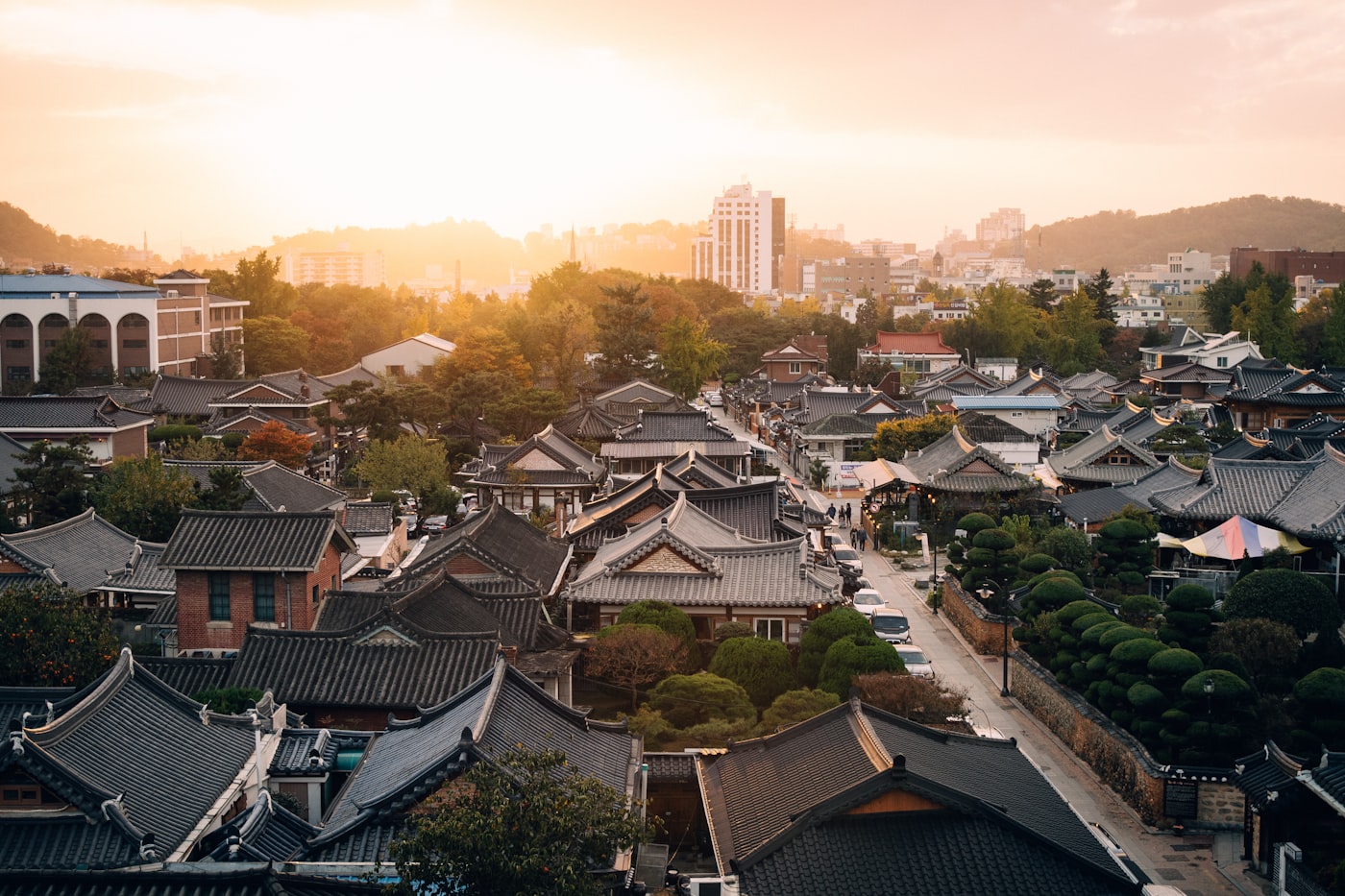
If you only read one Gyeongju Travel Guide — Korea’s Ancient Capital and UNESCO Heritage Sites before you go, let it be this one, because I want to save you from treating this extraordinary city the way most first-timers do — rushing through in a single day and wondering why it felt flat. Gyeongju doesn’t reveal itself at a glance. It unfolds slowly, like a thousand-year-old scroll, and the moment you start paying attention to the green burial mounds rising out of residential neighborhoods, the carved stone faces half-hidden in forest trails, and the lotus ponds that glow copper at dusk, you’ll understand why Koreans call it “a museum without walls.” I’ve walked every corner of this city over dozens of visits across twelve years, and it still surprises me.
Gyeongju served as the capital of the Silla Kingdom for nearly a thousand years — from 57 BC all the way to 935 AD — making it one of the longest-reigning ancient capitals anywhere on Earth. That deep, continuous history is exactly what UNESCO recognized when it designated multiple sites here as World Heritage properties. But beyond the plaques and the guidebook superlatives, what makes Gyeongju genuinely special is how effortlessly the ancient and the everyday coexist. You’ll find grandmothers doing their morning stretches in front of royal tumuli. Teenagers eat tteokbokki steps from a 1,300-year-old stone observatory. That layering of time is what no photograph fully captures — and why you need at least two full days here, ideally three.
Getting to Gyeongju and Finding Your Bearings
Getting to Gyeongju from Seoul is easier than most people expect. The fastest option is taking the KTX from Seoul Station to Singyeongju Station — that’s about 2 hours and costs roughly ₩59,800 (~$45) for a standard seat. Here’s the insider catch though: Singyeongju Station is actually about 20 kilometers outside the city center in a fairly empty area, so you’ll need to hop on bus 700 or 700-1 right outside the station exit (they run every 20–30 minutes and cost ₩1,650, ~$1.25) to reach downtown Gyeongju. Alternatively, slower but more convenient, the Mugunghwa train from Seoul drops you directly at Gyeongju Station right in the city heart — the journey takes around 4 hours and runs about ₩28,600 (~$22). Budget travelers, that’s your move. Once downtown, the city is genuinely walkable between the main clusters, though I strongly recommend renting a bicycle near Gyeongju Station for ₩5,000–8,000 per hour (~$3.75–$6) — it’s how locals navigate between the tumuli parks, Wolseong Palace, and Anapji Pond without fighting for taxis. The rental shops on Taejong-ro, the street running south from the station, open by 8:30am and most will give you a paper map that’s more useful than any app for this city.
Book your Gyeongju accommodation within walking distance of Hwangnam-dong (the old town neighborhood near the tumuli), not near Singyeongju Station where most budget hotels cluster. Staying in Hwangnam means you can walk to Cheomseongdae Observatory and Daereungwon Park before the tour buses arrive — ideally by 7:30am. The morning light on the burial mounds with zero crowds is one of the best free experiences in all of Korea.
The UNESCO Heritage Sites You Absolutely Cannot Miss
Gyeongju’s UNESCO-designated areas are grouped into distinct zones, and understanding that geography saves you from backtracking. Start your heritage trail at Daereungwon Tumuli Park in the Hwangnam district — this is the breathtaking field of enormous royal burial mounds right in the middle of the city, and entry is just ₩3,000 (~$2.25). You can walk the grassy pathways around and between the mounds, and one of them, Cheonmachong, is actually open inside so you can see the burial chamber reconstruction and the famous “Heavenly Horse” painting artifact. Most visitors spend 45 minutes here; I recommend 90. From there, it’s a seven-minute walk to Cheomseongdae Observatory — the oldest surviving astronomical observatory in East Asia, built in the 7th century during Queen Seondeok’s reign. There’s no entry fee, and no, you can’t go inside, but stand 10 meters back from it and look at the perfectly cylindrical stone structure rising from the flat ground and let that 1,300-year-old engineering sink in. Then make your way to Bulguksa Temple, which requires a separate trip — it’s 16 kilometers southeast of downtown, reachable by bus 10 or 11 from Gyeongju Intercity Bus Terminal (about 40 minutes, ₩1,650, ~$1.25). Bulguksa is the crown jewel of