Why I Think Every Visitor Should Try Korean Noodle Dishes
The first time I truly understood what Korean noodle dishes meant to people here, I was seven years old, sitting at my grandmother’s low wooden table in her apartment in Mapo-gu, watching her cut noodles directly into a simmering pot of anchovy broth. She wasn’t using a recipe. She wasn’t measuring anything. She was just making guksu — the way she had been making it for fifty years — and the smell alone was enough to make my whole body relax. That bowl of kalguksu she placed in front of me, with its thick hand-cut noodles and a few slices of zucchini floating in a golden broth, tasted like the specific warmth of being somewhere you completely belong. I’ve eaten Korean noodle dishes in fancy Seoul restaurants with international Michelin recognition, in underground pojangmacha stalls at 1am, in school cafeterias, and in regional diners that only old-timers know about. Nothing has ever fully displaced that feeling.
And here’s what I want foreign visitors to understand before they start their Korean noodle journey: this is not a category of food. It is a cultural landscape. When Koreans say guksu or myeon, they’re not just describing a carbohydrate in a bowl. They are describing an entire tradition of comfort, celebration, seasonality, and regional identity. The long noodle has historically symbolized long life and lasting happiness in Korean culture — which is why you’ll find noodles served at birthday feasts and wedding banquets to this day. The shape, the texture, the temperature of the broth, the specific condiments placed on the side — all of it carries meaning that most travel articles never bother to explain.
I’ve had foreign friends visit me in Seoul who spent a week eating bibimbap and Korean BBQ every single day because they didn’t quite know where to start with noodles. One of them, a food writer from London named Claire, told me she felt “intimidated by the cold soup concept” when she saw naengmyeon on a menu. By the time she left Korea, cold buckwheat noodles in tangy dongchimi broth had become the dish she was most desperate to find back home. That transformation — from confusion to obsession — is exactly what I want to help you navigate.
This guide covers the full picture: what these dishes actually are, where they come from, how Koreans actually eat them (which is often quite different from how they’re presented in tourist-facing media), the regional variations that most visitors never discover, and the honest mistakes that even well-traveled food lovers make when they sit down in a Korean noodle house for the first time. Whether you’re planning your first trip or you’ve been to Seoul before and feel like you’ve only scratched the surface — this is the guide I wish someone had handed me to give my foreign friends years ago.
My neighbor Mrs. Jang used to say, “You can tell a lot about a restaurant by how they treat their noodle water.” I didn’t fully understand what she meant until I watched a good kalguksu cook refuse to rush the anchovy stock — standing over the pot, adjusting the flame, tasting with a small spoon every few minutes. The noodle water, the broth, the foundation — that’s where the whole story begins.
What Korean Noodle Dishes Actually Are (And Where They Came From)
The Roots: China, the Korean Peninsula, and 4,000 Years of Noodle History
According to historical records, the earliest noodles in Asia trace back to China approximately 4,000 years ago, and noodle culture gradually spread across East Asia, reaching the Korean peninsula through cultural exchange during the ancient and medieval periods. In Korea, these noodles are collectively referred to as guksu (국수) in native Korean, or myeon (면) when written using hanja (Chinese characters). Both words refer to the same broad category, though over time they’ve developed slightly different connotations — guksu often feels more domestic and traditional, while myeon tends to appear in more formal or written contexts, and in the names of specific dishes like naengmyeon or jjamppong.
What’s fascinating about Korean noodle history is how deeply it reflects the agricultural and geographical realities of the peninsula. For most of Korea’s history, wheat was not a dominant crop — rice, barley, buckwheat, and various starches were far more common. This is why traditional Korean noodles are so remarkably diverse in their base ingredients: buckwheat, sweet potato starch, potato starch, acorn flour, kudzu, even corn flour in mountainous regions. Wheat flour noodles, called milguksu (밀국수), only became a true daily staple after 1945, largely due to the availability of American wheat flour in the post-liberation and post-war periods. Before that, wheat noodles were considered somewhat of a luxury, which explains why wheat-based noodle dishes were historically associated with celebrations and feasts.
The Royal Court Tradition
In the Joseon dynasty royal court, noodles were elevated to an art form. The most prestigious noodle dish was baekmyeon (백면, literally “white noodles”) — buckwheat noodles served in an elegant broth made from pheasant. The whiteness and delicacy of the noodles, combined with the rare and refined pheasant broth, marked this as a dish fit for royalty. Meanwhile, naengmyeon — now beloved by everyone from schoolchildren to office workers — was also enjoyed at court, specifically during the summer months, where it was served in a cold soup mixed with dongchimi (watery radish kimchi brine) and beef brisket broth. The juxtaposition is remarkable: a dish now found in affordable chain restaurants across Seoul was once a privileged pleasure of the aristocracy.
This historical tension between humble and refined is something I find endlessly interesting about Korean food. The noodle has always managed to live in both worlds simultaneously.
Regional Origins and the Birth of Signature Dishes
Korea’s geography — with its distinct provinces, mountain ranges, coastal areas, and climate zones — produced radically different noodle traditions that persist to this day. Naengmyeon is originally a winter dish and a local specialty of the Ibuk region (이북지방), which is the area now comprising modern-day North Korea. The cold climate there made buckwheat cultivation practical, and the icy broth was designed to preserve and highlight those earthy, slightly nutty flavors. When North Korean refugees and migrants moved southward following the Korean War, they brought naengmyeon with them, and it eventually spread across the entire country.
Makguksu, a buckwheat noodle dish in a savory sauce or light broth, became the signature comfort food of Gangwon Province — the mountainous northeastern region where buckwheat grows abundantly. Chuncheon, the provincial capital, is particularly famous for it. Gogi-guksu (고기국수), a pork-based noodle soup, represents Jeju Island’s distinct culinary tradition, reflecting the island’s historical reliance on pork as a primary protein. Milmyeon (밀면), a noodle dish unique to Busan, was born from naengmyeon but adapted to use wheat flour noodles — partly because wheat flour was more readily available in the port city during the post-war period when North Korean refugees settled there. And jjolmyeon (쫄면), with its famously chewy noodles in a spicy sauce, is proudly claimed by Incheon as its own creation.
As referenced by the Korea Tourism Organization, these regional noodle identities remain a significant part of local cultural pride and are actively promoted as culinary tourism destinations across the country.
The Modern Era: Adaptation Without Losing the Thread
Today’s Korean noodle landscape includes jjamppong — a fiercely spicy wheat noodle soup with seafood and vegetables that came into Korea through Chinese-Korean culinary exchange and has since become completely naturalized — and instant noodles (ramyeon), which deserve their own entire cultural essay. The point is that Korean noodle culture has never been static. It has absorbed influences, adapted to available ingredients, responded to historical upheaval, and still managed to retain an unmistakable Korean character. When you slurp a bowl of kongguksu on a humid Seoul afternoon and taste that cool, silky soybean broth, you are tasting something that is entirely Korean — even though soybeans and noodles themselves arrived from elsewhere.
For a deeper dive into the cultural and culinary significance of these dishes, the Korean Food Promotion Institute (Hansik) maintains excellent resources in English that trace the historical development of Korean noodle traditions with scholarly detail.
How Koreans Actually Eat Korean Noodle Dishes
The Ritual of Sitting Down: What the Table Tells You
One of the first things I tell foreign friends when they sit down at a Korean noodle restaurant is: pay attention to what’s already on the table before you’ve even ordered. In most dedicated noodle restaurants, particularly those specializing in naengmyeon or kalguksu, you’ll find small dishes of banchan (side dishes) already waiting for you. These aren’t optional extras — they are part of the meal’s architecture. A plate of kimchi, a small dish of kkakdugi (cubed radish kimchi), maybe some sliced scallions or pickled vegetables. These are meant to be eaten alongside and between bites of your noodles, providing contrast in temperature, texture, and flavor.

In Korean dining culture, the bowl of noodles is the centerpiece, but the meal is understood as a totality. You eat a bit of noodle, some broth, a piece of kimchi, back to the noodle. It’s a rhythm, not a race.
Chopsticks, Scissors, and the Spoon Question
This surprises many visitors: Koreans use both chopsticks and a spoon at a noodle meal. The spoon is for drinking broth. The chopsticks are for lifting noodles and solid ingredients. You’ll notice that Korean chopsticks are typically metal and slightly flatter than Chinese or Japanese versions — they’re designed to grip slippery noodles with more precision. If you find your noodles too long (and some bowls come with dramatically long noodles that seem nearly impossible to manage), it is completely acceptable to ask for scissors. Many noodle restaurants in Korea actually have scissors on the table or will bring them without being asked. Do not feel embarrassed about this. Koreans use scissors to cut noodles, meat, seaweed — it’s a completely normal part of the table toolkit.
What you should not do is stab your chopsticks vertically into the noodles and leave them standing upright in the bowl. This resembles the incense offerings made at ancestral memorial ceremonies and is considered deeply disrespectful. It’s one of those etiquette points that no one will loudly correct you for, but locals will notice.
Condiments and Customization: The Korean Way
Here’s something most travel articles miss entirely: Koreans aggressively customize their noodle bowls at the table. When naengmyeon arrives, for example, it is standard practice to taste the broth first, then add vinegar (식초) and/or mustard (겨자) from the small containers provided, adjusting the flavor to your personal preference. The server may even add these for you and ask if it’s enough. This isn’t the restaurant telling you the dish is incomplete — it’s an invitation to make it yours.
For spicy mixed noodles like bibim guksu or bibim naengmyeon, some restaurants bring extra gochujang-based sauce on the side so you can increase the heat. For warm soups like kalguksu or janchi guksu, you might find small dishes of seasoning sauce — typically a blend of sesame oil, soy sauce, scallions, and a touch of chili powder — meant to be stirred into the bowl as you eat. These sauces are not poured all at once. You add a little, taste, add more. The entire philosophy is one of gradual, personal calibration.
What to Drink with Noodles
At most noodle-focused restaurants in Korea, the default drink is boricha (roasted barley tea) or plain water — served cold or hot depending on the season, usually for free. Alcohol is less common at dedicated noodle restaurants during lunch, though makgeolli (Korean rice wine) pairs beautifully with kalguksu and is frequently ordered when the meal becomes a more leisurely affair. At naengmyeon restaurants, I’ve often seen people order soju alongside their meal — the bracing cold broth and the clear spirit create a combination that Koreans find deeply satisfying, particularly in summer.
| Noodle Dish | Typical Banchan | Why It Works |
|---|---|---|
| Naengmyeon | Kkakdugi (radish kimchi), sliced brisket | Cuts through the icy broth; adds protein and chew |
| Kalguksu | Baechu kimchi, seasoned spinach | Fermented acidity balances the mild anchovy broth |
| Kongguksu | Kkakdugi, cucumber kimchi | Crunchy contrast to the creamy soybean broth |
| Bibim Guksu | Steamed egg, simple doenjang soup | Cooling egg and mild soup temper the spice |
| Janchi Guksu | Seasonal namul, simple radish soup | Light sides preserve the celebratory delicacy of the dish |
The Main Types and Variations of Korean Noodle Dishes
Warm Noodle Soups: Comfort in a Bowl
Kalguksu (칼국수) is the dish I’d recommend to almost any first-time visitor who is nervous about trying Korean noodles. The name literally means “knife-cut noodles” — kal means knife — and the thick, slightly chewy wheat flour noodles are served in a large bowl of seafood-based or anchovy-based broth with vegetables and sometimes clams or zucchini. It’s a deeply comforting dish, not aggressively spiced, and the texture of the handmade noodles is unlike anything you get from a dried pasta. Most good kalguksu restaurants make the dough fresh daily. When the noodles are properly made, they have a slight resistance, a density that machine-cut noodles never quite achieve. Myeongdong and Insadong both have strong kalguksu traditions, and the Namdaemun Market area is famously associated with some of Seoul’s most beloved kalguksu spots.
Janchi guksu (잔치국수) is the noodle dish you encounter at weddings, birthday parties, and any occasion worth celebrating. The name comes from janchi, meaning feast or banquet. Thin wheat flour noodles arrive in a clear, delicate broth made from anchovies and sometimes kelp or beef stock, topped with strips of fried egg (jidan), slivers of seaweed (gim), and sliced zucchini. A small dish of seasoning sauce — sesame oil, soy sauce, scallions, a whisper of chili — sits on the side. The dish is intentionally modest in appearance, but the philosophy behind it is profound: the long, continuous noodle symbolizes longevity and lasting happiness. When an elderly Korean relative asks if you’ve eaten guksu yet at a birthday party, they are asking both a literal and a symbolic question.
Jjamppong (짬뽕) deserves its own monument. This spicy seafood noodle soup — wheat noodles in a fiercely red, umami-packed broth loaded with shellfish, squid, vegetables, and sometimes pork — arrived in Korea through the Chinese-Korean community and has been so thoroughly adopted that most Koreans would be baffled if you suggested it wasn’t fundamentally Korean. The heat level in a good bowl of jjamppong is serious. This is not decorative redness. When I first brought a British friend to a jjamppong specialist in Seoul, he finished the bowl, looked slightly dazed, and said, “That’s the best thing I’ve ever had that also genuinely hurt me.” High praise, in my opinion.
Cold Noodle Dishes: The Summer Soul of Korean Food
Naengmyeon (냉면) is arguably the most culturally significant noodle dish in Korea, and also the one most likely to confuse or initially disappoint a foreign visitor who arrives without context. Thin, slightly elastic buckwheat noodles — with a characteristic chewiness that takes some getting used to — are served either in a tangy, ice-cold broth (mul naengmyeon) or tossed in a spicy, vinegary gochujang-based sauce without broth (bibim naengmyeon). The broth version, mul naengmyeon, is typically made from a combination of beef broth and dongchimi (watery radish kimchi brine), creating a flavor that is simultaneously savory, sour, and deeply refreshing. Standard toppings include thin slices of pickled radish, cucumber julienne, a slice of Korean pear, and a piece of cold braised beef brisket. Half a hard-boiled egg sits on top. It is beautiful to look at and quietly startling to eat for the first time.
Kongguksu (콩국수) is summer in a bowl. Cold, freshly ground soybean milk — thick, nutty, slightly earthy — is poured over thin wheat noodles and served with a pinch of salt on the side. That’s it. The restraint is the point. I watch foreign visitors approach kongguksu with visible uncertainty — the pale, almost beige broth doesn’t look like much — and then watch their faces change after the first slurp. The soybean broth is surprisingly rich and satisfying, like a cold, savory version of something you can’t quite name. It’s typically available only during summer months, which makes it a seasonal ritual rather than a year-round option.
Bibim guksu (비빔국수) is the dish I ate most frequently in my school cafeteria growing up. Thin wheat flour noodles tossed in a bright, punchy sauce of gochujang and vinegar, topped with half a hard-boiled egg, cucumber slices, and sometimes kimchi. It’s tangy, spicy, sweet, and deeply moreish. The word bibim means “mixed,” and the eating of this dish requires active participation — you mix everything together vigorously before eating, distributing the sauce through every strand of noodle. It’s chaotic, colorful, and completely satisfying.
The Chewy Outliers: Jjolmyeon and Milmyeon
Jjolmyeon (쫄면) is Incheon’s gift to Korean noodle culture. Thick, extraordinarily chewy noodles — the texture is almost springy, like a satisfying resistance to every bite — served cold with a spicy, tangy sauce similar to bibim naengmyeon’s dressing. The chewiness is not a flaw; it is the entire point. Jjolmyeon noodles are made to be bouncy and resilient, and once you adjust to that texture, you find it oddly addictive. It’s a favorite street food and casual restaurant dish, particularly popular among younger Koreans.
Milmyeon (밀면) is Busan’s proudly local noodle dish. Born from the post-war adaptation of naengmyeon using more readily available wheat flour, milmyeon uses flat wheat-starch noodles served cold, either in a cold broth or mixed with sauce. If you visit Busan and you don’t eat milmyeon at least once, longtime Busan residents will consider your trip incomplete.
Regional and Specialty Varieties Worth Seeking Out
| Dish | Region | Base Ingredient | Key Characteristic |
|---|---|---|---|
| Makguksu | Gangwon Province (Chuncheon) | Buckwheat | Served in broth or sauce; earthy, hearty |
| Gogi-guksu | Jeju Island | Wheat, pork broth | Rich pork-based broth with sliced pork |
| Milmyeon | Busan | Wheat/starch blend | Cold, flat noodles; naengmyeon’s southern cousin |
| Olchaengi guksu | Gangwon Province (mountains) | Dried corn flour | Unusual corn-based noodle; rustic and distinctive |
| Jjolmyeon | Incheon | Wheat/starch blend | Extremely chewy; spicy mixed noodle |
| Jatguksu | Gapyeong, Gyeonggi Province | Wheat or buckwheat | Cold pine nut broth; clean, savory, delicate |
| Kongguksu | Nationwide (summer only) | Wheat (soybean broth) | Cold soy milk broth; creamy and nutty |
Japchae: The Noodle Dish That Doubles as a Side
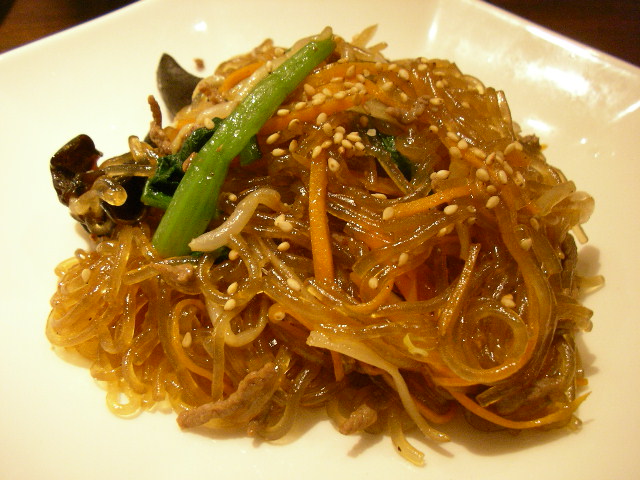
No discussion of Korean noodle dishes is complete without japchae (잡채). Made from dangmyeon — glass noodles produced from sweet potato starch — japchae is stir-fried with thinly sliced beef, mushrooms, spinach, carrots, and other vegetables, seasoned with soy sauce and sesame oil. It can be served warm or at room temperature, and while it technically functions as a banchan (side dish), it’s substantial enough to anchor a meal. Japchae is a staple of Korean celebrations — birthdays, Chuseok, Lunar New Year — and the dangmyeon noodles have a beautifully slippery, slightly translucent quality when properly cooked. If you see japchae on a menu as a main dish, often served over rice, order it. You will not regret this decision.
Where to Find Good Korean Noodle Dishes (And How to Spot a Good Place)
Seoul Neighborhoods with Strong Noodle Cultures
Seoul is enormous and noodle options exist in every neighborhood, but some areas have developed particularly strong reputations. The area around Euljiro and the old city center has clusters of workingman’s noodle restaurants that have been operating for decades, serving kalguksu and janchi guksu to the kind of lunch crowds that include everyone from construction workers to corporate lawyers. These places tend to be small, slightly dingy in the best possible way, and completely uninterested in being photographed. They’re also frequently extraordinary.

Namdaemun Market and the surrounding streets have a famous kalguksu alley (칼국수골목) that has been feeding Seoul residents for generations. The atmosphere at lunch is controlled chaos — ajummas (older women) moving between tables with steaming pots, customers shouting orders over the noise of the market. This is how most Koreans actually experience kalguksu, not in quiet restaurant booths.
For naengmyeon, Mapo-gu and the area near Seoul Station have long been associated with North Korean-style naengmyeon restaurants — places established by families who came south after the Korean War and have been making the same broth recipe for seventy years. The concentration of these restaurants in certain neighborhoods reflects the settlement patterns of North Korean migrants, which is a piece of living history you’re eating when you sit down in one of these places.
In Busan, the area around Seomyeon and the older neighborhoods near Bupyeong Market are good hunting grounds for milmyeon and gogi-guksu-influenced dishes. In Chuncheon, Gangwon Province, the streets near Chuncheon Station have long rows of makguksu restaurants that are well worth a day trip from Seoul.
How to Spot a Genuinely Good Noodle Restaurant
After fifteen years of eating noodles all over this city and country, I’ve developed a set of reliable signals. First: look at the kitchen setup. In a good kalguksu place, you should be able to see or hear evidence that the broth is being made on-site — the smell of simmering anchovies or beef bones, the sight of stock pots on active burners. Second: look at the clientele at lunchtime. If the restaurant is full of older Korean regulars who appear to be eating as a habit rather than an event, that’s a very good sign. Third: check how the noodles look when they arrive. Properly made fresh kalguksu noodles are slightly uneven — hand-cut, not machine-uniform. For naengmyeon, the noodles should have a slight grayish-brown hue from the buckwheat, not a uniform beige.
Fourth, and perhaps most practically: if the restaurant does one or two things on the menu and nothing else, it is almost certainly doing those things very well. Specialization is a marker of quality in Korean noodle culture. A restaurant that only makes mul naengmyeon and bibim naengmyeon has been doing exactly those two things, possibly for decades. Trust the specialist.
For visitors who want structured guidance before arriving in Korea, both the Korea Tourism Organization and Seoul Tourism’s official food guide maintain updated restaurant directories organized by food type and neighborhood, which can help you identify well-regarded establishments in the areas you’re planning to visit. Always verify hours and seasonal availability before making a special trip.
Reading the Menu: What to Look For
Korean noodle restaurant menus are often short and specific, which makes them less intimidating than they look. For a naengmyeon restaurant, you’ll almost always see just two main options: mul naengmyeon (물냉면, the broth version) and bibim naengmyeon (비빔냉면, the spicy mixed version). You might also see 온면 (onmyeon) — a warm noodle option for those who want something hot. For kalguksu restaurants, the main variation is usually the type of broth: seafood-based, anchovy-based, or occasionally chicken or beef. Don’t stress about making a wrong choice. At the price point of most Korean noodle restaurants, ordering a second bowl if you want to try something different is a very reasonable option.
If you want to explore more of Seoul’s restaurant culture beyond noodles, check out our Korean restaurant guide for neighborhood-by-neighborhood recommendations across all major food categories.
Honest Mistakes Foreigners Make with Korean Noodle Dishes
Expecting All Korean Noodles to Be Spicy (Or Expecting None to Be)
This is probably the most common miscalibration I see. Foreign visitors tend to arrive with either the assumption that all Korean food is blisteringly spicy, or — after reading a few articles about delicate doenjang jjigae and clean broths — with the opposite assumption that the spice reputation is exaggerated. Both are wrong when applied to noodles. Korean noodle dishes cover the full spectrum from completely mild (kongguksu, janchi guksu, gomguksu) to genuinely ferocious (jjamppong, some versions of bibim guksu with extra gochujang). The key is understanding which category you’re ordering from. Look for the word 매운 (maewoon, meaning spicy) on menus, or simply ask. Most restaurant staff in Seoul’s central tourist areas have enough English to answer this question, and pointing at a menu item and making a questioning gesture about spice level will be universally understood.
Pouring the Broth Away Instead of Drinking It
I’ve watched this happen multiple times with foreign visitors at naengmyeon restaurants. The cold broth arrives and looks so pale and watery — almost like slightly flavored ice water — that some diners assume it’s a cooking liquid or a cleaning rinse and push it aside. Please do not pour away your naengmyeon broth. That broth is the dish. It is carefully made from a combination of beef stock and dongchimi brine, chilled to just above freezing, and seasoned with precision. Sipping it between bites of noodle is not optional — it’s the entire eating experience. Add vinegar and mustard to taste, as described earlier. Drink it. Appreciate it.
Mixing Everything Immediately (Before Tasting the Broth)
For mul naengmyeon in particular, I recommend tasting the broth on its own first, before you add condiments or mix anything. This gives you a baseline understanding of what the kitchen has built — you can taste the beef broth, the dongchimi sourness, the specific seasoning choices of that particular restaurant. Then you add your vinegar and mustard in small increments. Then you eat a strand of noodle by itself to appreciate the buckwheat flavor. Then you start mixing in the toppings. This sounds overly ceremonious, but it’s genuinely the way to get the most out of the dish. Dumping everything in and mixing immediately means you’re not actually tasting naengmyeon — you’re tasting a generic combination of flavors that could have come from anywhere.
Assuming the Long Noodles Are a Problem to Solve
Some visitors approach their bowl of kalguksu or janchi guksu and immediately start cutting the noodles into short pieces with their chopsticks, apparently under the impression that this makes them easier to eat. While scissors are genuinely provided at many restaurants and using them is fine, there’s something worth knowing: the long, uncut noodle is traditionally meaningful. In the context of janchi guksu especially — the celebratory birthday or wedding noodle — cutting the noodles prematurely is symbolically associated with cutting a life short. Nobody will scold you or make a scene, but it’s a piece of cultural context worth being aware of. Learn to twirl your noodles around your chopsticks instead. It takes about three minutes of practice and is infinitely more satisfying.
Ordering Naengmyeon in Winter Without Knowing What You’re Getting Into
Naengmyeon is available year-round in most restaurants, but it’s worth knowing that it was historically a winter dish in its region of origin, and some traditionalist establishments make the broth slightly less intensely cold in cooler months. However, most modern naengmyeon restaurants in Seoul serve it at the same icy temperature regardless of season. Ordering a bowl of mul naengmyeon when there’s snow on the ground is considered something of a Korean personality statement — a sign of robustness, a refusal to be dictated to by weather. Many Koreans do this deliberately. If you order naengmyeon in January, your server might smile at you with a kind of amused respect. Lean into it.
A Canadian friend of mine named David visited in February and ordered mul naengmyeon at a restaurant near Gyeongbokgung Palace. He was wearing two coats. The bowl arrived so cold there was visible vapor rising from it. He ate the entire thing, added extra vinegar halfway through, and afterward said — somewhat breathlessly — “I completely understand this country now.” I think he was onto something.
Skipping the Regional Dishes in Favor of Only Seoul Staples
This is less of an etiquette mistake and more of a strategic one. If your Korea trip includes only Seoul, you will still eat excellent noodles — but you’ll miss the full picture. Makguksu in Chuncheon, milmyeon in Busan, gogi-guksu in Jeju: these dishes don’t travel well, and the experience of eating them in their home regions, surrounded by locals for whom these foods are a point of identity, is categorically different from eating a Seoul-restaurant interpretation. If you’re in Seoul and genuinely can’t make it to the regions, that’s understandable. But if your itinerary has any flexibility, plan at least one noodle-focused food journey outside the capital. You will not regret it.
If you’re interested in understanding the language of Korean food menus before your trip, our Korean language basics for food travelers guide covers essential dining vocabulary, including noodle-specific terms, that will make ordering dramatically less stressful.
FAQ: Korean Noodle Dishes — Questions Foreign Visitors Actually Ask
Are Korean noodle dishes generally gluten-free?
Not reliably. Many Korean noodles — including kalguksu, janchi guksu, jjamppong, and bibim guksu — are made from wheat flour. However, buckwheat-based noodles (used in naengmyeon and memil guksu) and starch-based noodles (dangmyeon from sweet potato starch, gamja guksu from potato starch) are wheat-free. The complication is that wheat is also often present in soy sauce and other seasonings used in the broth or sauce, so cross-contamination is a real concern. If you have celiac disease or serious gluten sensitivity, you need to communicate this clearly to restaurant staff. “밀가루 알레르기가 있어요” (mil-ga-ru al-le-rŭ-gi-ga i-ssŏ-yo) means “I have a wheat flour allergy” and is worth memorizing or keeping on your phone.
Is naengmyeon eaten cold in winter too?
Yes, absolutely. While it originated as a winter dish in the northern region of Korea (now North Korea), it is eaten year-round by Koreans who enjoy it regardless of weather. Eating naengmyeon in the middle of winter is considered a mark of toughness by some Koreans. The broth is served at a temperature close to freezing in most restaurants regardless of season.
What’s the difference between naengmyeon and bibim guksu?
Both are cold noodle dishes with spicy-tangy elements, but they’re quite different. Naengmyeon uses buckwheat noodles, which are darker, chewier, and more elastic. Bibim guksu uses thin wheat flour noodles, which are softer and lighter. Naengmyeon’s bibim version (bibim naengmyeon) has a richer, more complex sauce made with chogochujang. Bibim guksu’s sauce is simpler and often brighter in flavor. They’re in the same flavor family but different eating experiences.
Can vegetarians eat Korean noodle dishes?
This requires some navigation. Many Korean noodle broths are made with anchovy, beef bone, or pork — animal products that vegetarians or vegans need to avoid. Kongguksu (cold soybean broth noodles) is naturally vegan-friendly. Some restaurants will make vegetable-based broths on request, though this is not universal. Bibim guksu and bibim naengmyeon, which use sauce rather than broth, can sometimes be made without animal products, but the sauce may contain fish sauce. It’s worth asking specifically: “채식주의자예요, 고기 없이 될까요?” (chae-sik-ju-ŭi-ja-ye-yo, go-gi ŏp-si dwel-kka-yo?) — “I’m vegetarian, is it possible without meat?” Temple food restaurants (사찰음식 restaurants) often offer genuinely vegan noodle options.
How do I know if a naengmyeon restaurant makes good broth?
The honest answer is: you often don’t know until you taste it. But there are signals. A restaurant that makes its own dongchimi on-site (you may be able to see large earthenware pots or refrigerated kimchi storage) is likely making its broth with genuine ingredients. If the restaurant has been operating for many years and has a consistent local clientele, that’s a strong indicator. The broth itself should have a subtle, layered flavor — you should be able to taste beef stock, fermented radish brine, and a clean tanginess. If it tastes primarily of salt or MSG with no complexity, that’s a warning sign.
Is it rude to slurp noodles in Korea?
Slurping is not considered rude in Korea, and for noodles specifically it’s completely normal and practical. The real etiquette points to watch are: don’t stick chopsticks vertically in your bowl, don’t pour broth into other people’s bowls without asking, and don’t rush if you’re eating with older Koreans — the pace of the meal follows the eldest person’s rhythm. Otherwise, eat comfortably and don’t stress about making noise with your noodles.
What does japchae taste like, and is it always served as a side dish?
Japchae has a savory-sweet flavor profile — the soy sauce and sesame oil create a rich, nutty base, and the vegetables add freshness and color. The dangmyeon (sweet potato glass noodles) are silky and slightly chewy. It’s most commonly served as a side dish at Korean celebrations, but you’ll also find it served over rice as a main dish (japchae-bap) in many restaurants. Either version is worth ordering. It’s one of the more immediately approachable Korean noodle dishes for visitors who are nervous about strong fermented flavors or extreme spice.
What is gomguksu and where do I find it?
Gomguksu (곰국수) is wheat flour noodles served in a broth made from gomguk or gomtang — a long-simmered beef bone or cartilage broth that turns milky white and deeply rich during cooking. It’s one of those dishes that looks humble but tastes extraordinary if properly made. You’re most likely to find it at restaurants that specialize in gomtang (the broth served on its own or with rice), where gomguksu is an alternative option. The broth is mild, almost creamy, with a depth that comes from hours of simmering. It’s an excellent choice on cold days and for anyone who finds spicier Korean noodle dishes too intense.
How much does a bowl of Korean noodles typically cost?
While I won’t cite specific prices that might become outdated, Korean noodle restaurants are generally quite affordable compared to Western restaurant dining. Dedicated noodle restaurants at the everyday level — the kind locals use for regular meals — are typically budget-friendly, with prices scaling upward at more premium or specialized establishments. Market-area noodle stalls tend to be the most economical. Naengmyeon at a well-regarded traditional restaurant will cost more than kalguksu at a market stall, but by international dining standards, you’re rarely looking at prices that would cause sticker shock. Check current pricing through the Korea Tourism Organization’s food guides for the most up-to-date reference ranges.
What are the most important Korean noodle terms I should know before ordering?
| Korean | Romanization | What It Means |
|---|---|---|
| 국수 / 면 | Guksu / Myeon | Noodles (general term) |
| 물냉면 | Mul naengmyeon | Cold noodles in broth |
| 비빔냉면 | Bibim naengmyeon | Cold mixed noodles with sauce (no broth) |
| 칼국수 | Kalguksu | Knife-cut noodle soup |
| 콩국수 | Kongguksu | Cold noodles in soybean broth |
| 매운 | Maewoon | Spicy |
| 안 매운 | An maewoon | Not spicy |
| 육수 | Yuksu | Broth / stock |
| 고명 | Gomyeong | Garnish / toppings |
| 식초 | Sikcho | Vinegar (for adding to naengmyeon) |
| 겨자 | Gyeoja | Mustard (for adding to naengmyeon) |
For a more complete vocabulary list covering all aspects of Korean dining, visit our Korean language guide for food travelers, where we break down essential phrases for everything from ordering and asking about ingredients to expressing your spice tolerance.
Final Thoughts from a Local
I’ve been eating Korean noodle dishes my entire life, and I still discover new things. Last year, visiting a relative in Gangwon Province, I ate olchaengi guksu for the first time — those unusual corn flour noodles from the mountain villages — and was genuinely surprised by how distinct the texture and flavor were from everything else I’d eaten before. The noodle slid from the colander into a cold, lightly seasoned broth with a kind of gentle thud, and the corn flavor was unmistakable and somehow both rustic and sophisticated simultaneously. I’m forty-two years old. I’ve been eating Korean noodles since before I could hold chopsticks properly. And I’m still having first experiences.
That’s the thing about Korean noodle culture that I most want foreign visitors to understand and carry with them. This is not a category to be completed. It’s not a checklist. The idea that you can “do” Korean noodles on a trip to Seoul is like saying you can “do” Italian pasta on a trip to Rome — technically possible in a surface sense, but missing the depth entirely. The best approach is to come curious, order things you don’t fully understand, add your vinegar in small increments, drink your broth slowly, and let the people around you show you what they love about what they’re eating.
My grandmother passed away eight years ago. At the meal after her funeral, someone brought a large pot of kalguksu — hand-cut noodles in anchovy broth, the way she always made it. We ate it quietly, sitting together, and it tasted exactly like her apartment in Mapo-gu on a cold afternoon when I was seven. This is what food does when it carries history. This is what Korean noodle dishes are, at their core: not recipes, not menu items, but living memory in a bowl.
Whether your first Korean noodle experience is a bowl of jjamppong that makes your eyes water in a Myeongdong restaurant, a cool summer afternoon with kongguksu in a traditional hanok-style eatery, or a steaming bowl of kalguksu eaten standing up in Namdaemun Market — eat it fully. Be present in the bowl. And then come back for another one, because there are always more kinds of Korean noodle dishes than you think, and every single one of them has a story worth tasting.
For those planning their Korean food journey in more detail, the Korean Food Promotion Institute (Hansik) offers excellent English-language resources on the cultural context, nutritional profile, and regional distribution of traditional Korean dishes. The Korea Tourism Organization also maintains food-focused travel itineraries organized by region, including noodle-trail routes that connect several regional specialties across a single journey.
Good eating. Eat slowly. Drink your broth.
Leave a Reply