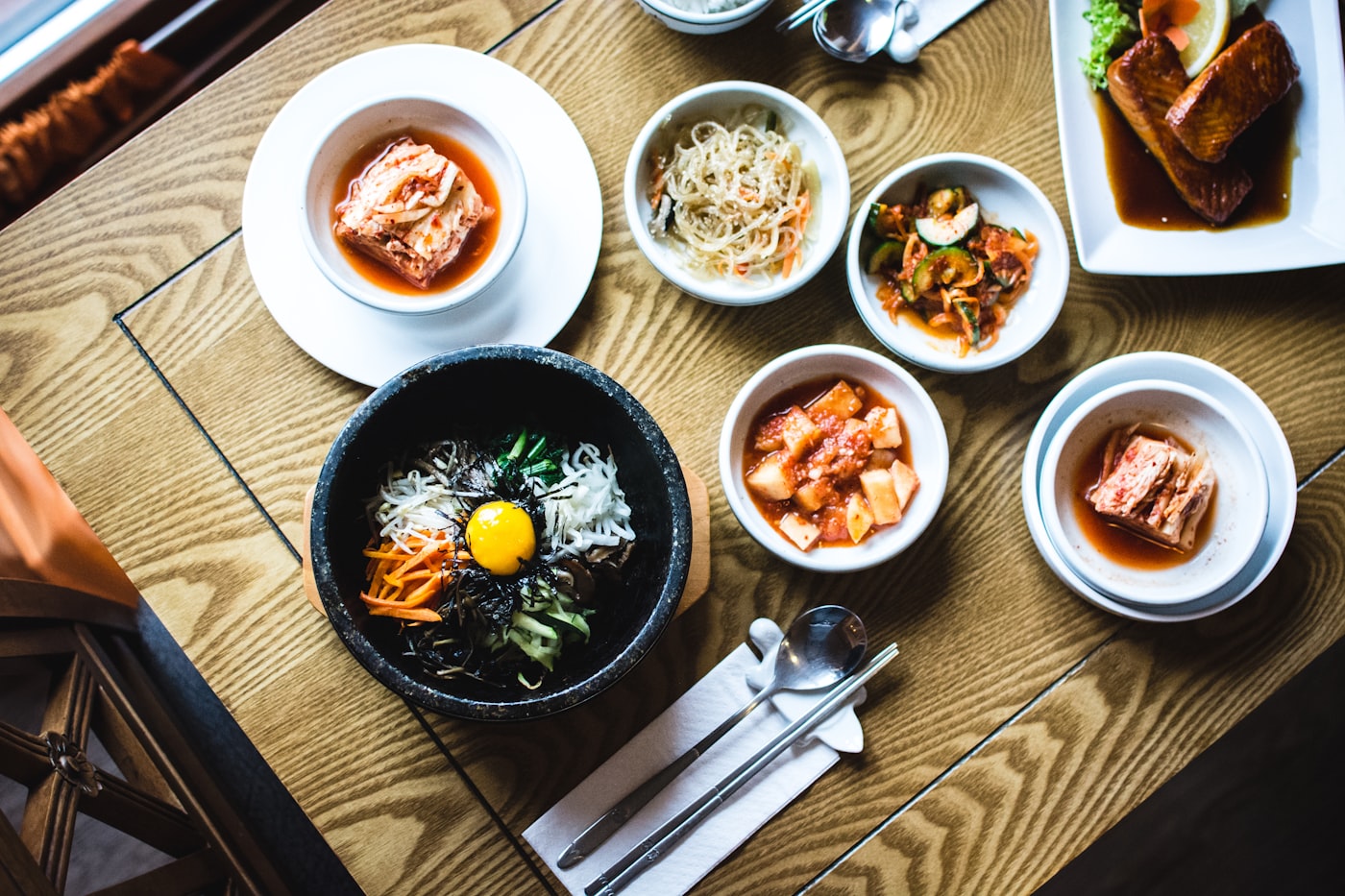
If you have ever dreamed of ordering confidently at a Korean restaurant, exploring a bustling Seoul street food market, or simply understanding what is on the menu at your favorite Korean BBQ spot, then mastering Korean Food Vocabulary — 60 Essential Words for Foodies is the single best first step you can take. Korean cuisine is one of the most celebrated in the world — from the sizzle of 삼겹살 (samgyeopsal) [sam-GYUP-sal] — “grilled pork belly” on a charcoal grill to the satisfying warmth of 김치찌개 (kimchi jjigae) [KIM-chee jji-geh] — “kimchi stew” — and learning its vocabulary opens up an entire culture, not just a menu.
Do not worry if you have never seen a single Korean letter before. Korean uses its own alphabet called 한글 (Hangeul) [HAN-geul] — “the Korean alphabet”, and the wonderful news is that it was scientifically designed to be learned quickly. Every pronunciation guide in this lesson uses plain English syllables so you can start speaking immediately — no special symbols, no confusion. By the end of this article, you will have 60 real, usable Korean food words stored in your memory.
Think of this lesson as your personal Korean food dictionary. We will cover everything from staple grains and proteins to vegetables, sauces, drinks, and essential restaurant phrases. You will also learn how Korean sentences work — because knowing a word is powerful, but knowing how to use it in a sentence is what makes you truly conversational. Let us dig in.
Understanding Korean Before You Begin — The Basics in 60 Seconds
Before we jump into Korean food vocabulary, let us get one foundational concept locked in. Korean is written in 한글 (Hangeul), an alphabet of 24 basic letters (14 consonants and 10 vowels) that combine into syllable blocks. For example, the word 밥 (bap) [BAP] — “cooked rice / a meal” looks like one block but is made of three sounds: ㅂ (b) + ㅏ (a) + ㅂ (p). Every Korean word in this article is shown in its full written form, its official romanization, and an English-friendly phonetic guide so nothing is left to guesswork.
One more thing to know: Korean word order is different from English. In English we say “I eat rice” (Subject → Verb → Object). In Korean, you say “I rice eat” (Subject → Object → Verb). The verb always lands at the end of the sentence. We will come back to this when we build food sentences later in the lesson — it is simpler than it sounds, and you will get it immediately with a clear example.
Korean Staple Foods — Rice, Noodles & Bread
Rice is the heartbeat of Korean cuisine. The word 밥 (bap) [BAP] — “cooked rice / a meal” is so central that Koreans often use it as a general word for any meal. When a Korean friend asks “밥 먹었어요? (bap meogeosseoyo?) [BAP MUH-gut-ssuh-yo]” — “Did you eat?”, they are literally asking “Did you eat rice?” — it is their way of saying “How are you?” Think of 밥 as the Korean word that holds an entire culture.
| Korean (한글) | Romanization | English Sound [phonetic] | English Meaning |
|---|---|---|---|
| 밥 | bap | [BAP] | “cooked rice / a meal” |
| 국수 | guksu | [GOOK-soo] | “noodles” |
| 라면 | ramyeon | [RA-myun] | “instant noodles / ramen” |
| 빵 | ppang | [PPANG] | “bread” |
| 떡 | tteok | [TTUK] | “rice cake” |
| 죽 | juk | [JOOK] | “rice porridge” |
💡 Teacher’s Tip
To remember 밥 (bap) [BAP] — “rice / meal”, think of it like this: when you eat a good meal, you “bap” your lips together in satisfaction. Simple, silly, and it sticks. For 떡 (tteok) [TTUK], imagine a duck (“ttuck” sounds like “duck”) sitting on a soft rice cake. These little mental images are your best friends when building Korean food vocabulary fast.
Famous Korean Dishes — The Must-Know Names
These are the iconic Korean food vocabulary words you will encounter in every Korean restaurant and recipe blog worldwide. Learning these names will make you feel immediately at home in Korean food culture.
| Korean (한글) | Romanization | English Sound [phonetic] | English Meaning |
|---|---|---|---|
| 김치 | kimchi | [KIM-chee] | “fermented spicy cabbage” |
| 비빔밥 | bibimbap | [bee-BIM-bap] | “mixed rice bowl with vegetables” |
| 불고기 | bulgogi | [bool-GO-gee] | “marinated grilled beef” |
| 삼겹살 | samgyeopsal | [sam-GYUP-sal] | “grilled pork belly” |
| 김치찌개 | kimchi jjigae | [KIM-chee jji-geh] | “kimchi stew” |
| 된장찌개 | doenjang jjigae | [DWEN-jang jji-geh] | “fermented soybean paste stew” |
Notice how many Korean dish names combine two words. 비빔밥 (bibimbap) [bee-BIM-bap] — “mixed rice bowl” is 비빔 (bibim) [bee-BIM] — “mixing” plus 밥 (bap) [BAP] — “rice”. You already know 밥 from the previous section! This is how Korean vocabulary builds on itself — learn one word and you have unlocked pieces of dozens more. The suffix 찌개 (jjigae) [JJI-geh] — “stew” appears in many dish names, so once you know it, you can identify any Korean stew on a menu instantly.
Vegetables, Proteins & Ingredients
Korean cooking relies on a beautiful range of fresh and fermented ingredients. Here are the essential Korean food vocabulary words for common vegetables and proteins you will see in recipes and on restaurant menus every

