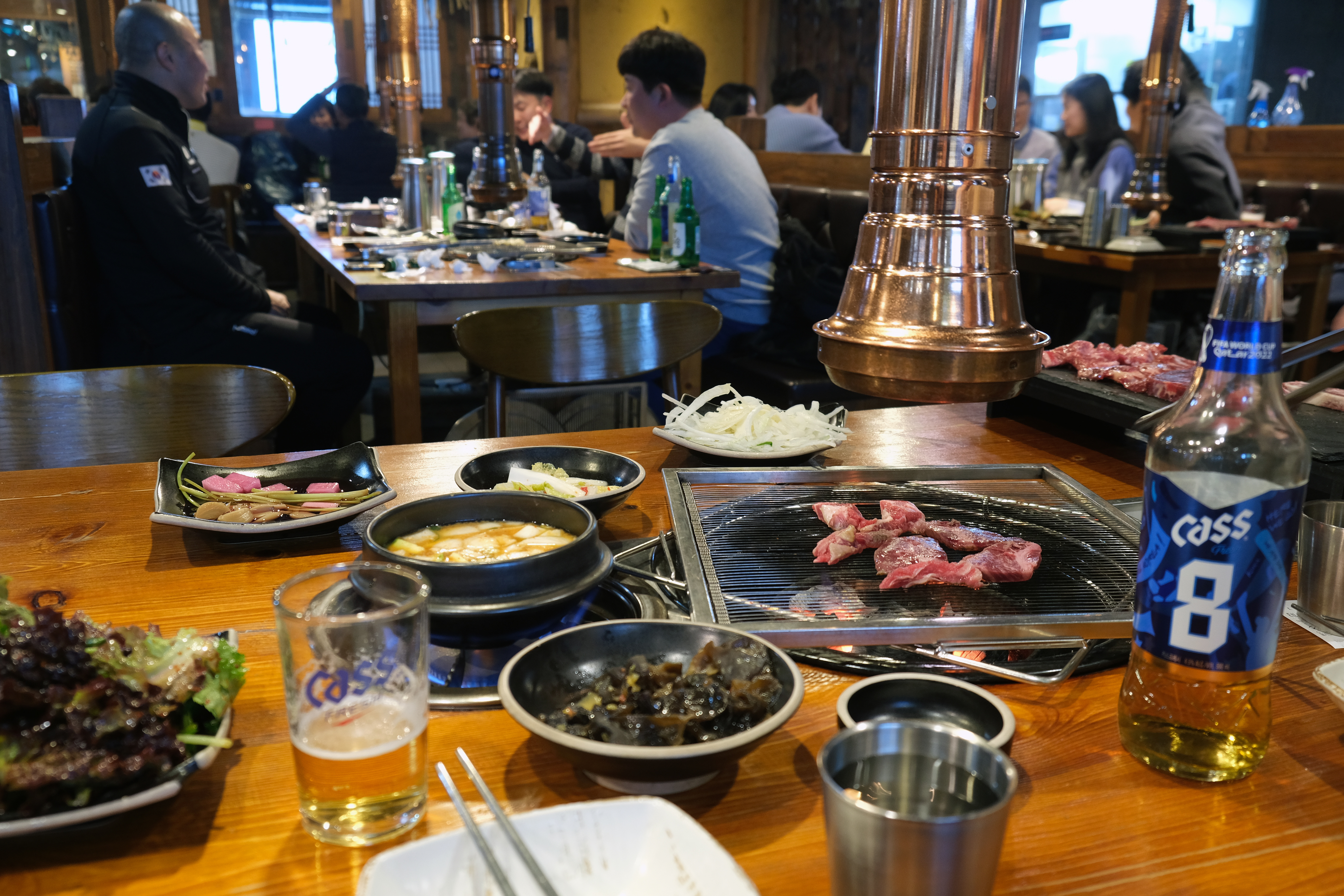
Why I think every visitor should try Korean BBQ
The first time I truly understood what Korean BBQ meant — not just as food, but as an experience — I was nine years old and sitting cross-legged on a vinyl floor cushion in a tiny neighborhood restaurant in Mapo-gu, Seoul. My father had ordered galbi, and the ajumma running the place was fanning the charcoal with a handheld fan, sending little sparks dancing toward the low ceiling. My job, he told me, was to watch the meat and tell him when it started to curl at the edges. I felt incredibly important. I burned three pieces before getting the timing right. I have never forgotten that evening.
That memory is exactly why I think every visitor to Korea should eat Korean BBQ — not just once, but multiple times, in multiple settings. Because this is not simply a meal. It is a ritual. It is a reason to sit down for two hours on a Tuesday night and not check your phone. It is a format for conversation, for drinking together, for taking turns grilling the meat and cutting it into smaller pieces for the person you care about. In Korea, we have a verb for it: 고기 굽다 (gogi-gupda), to grill the meat. And when someone says “Let’s go grill some meat tonight,” you know they mean let’s spend real time together.
What most travel articles about Korean BBQ get wrong is that they treat it like a theme-park version of eating — a novelty, something exotic, a photo opportunity. They tell you what to order and show you a picture of samgyeopsal sizzling on a grate, and they leave it at that. That has never felt right to me. After fifteen years of living in Seoul as an adult, and a childhood before that eating this food at school cafeterias (yes, bulgogi appeared in our lunch rotation roughly once every two weeks, and it was the best day), at home on weekends, at neighborhood pojangmacha carts, and at proper restaurants for birthdays and promotions — I feel like I owe you something more honest and more useful than a listicle.
I remember bringing my Australian friend Ji-hye — she’d never eaten Korean food before — to a samgyeopsal restaurant in Hongdae on her third day in Seoul. She spent the first ten minutes trying to figure out how to use the tongs. By the end of the night she was grilling on her own, wrapping the pork belly in perilla leaves, and asking if she could order one more round. She told me it was the most fun she’d ever had eating dinner. I wasn’t surprised. That’s just what this food does to people.
So this guide is not going to hand you a script. It is going to hand you context — the kind of context that will make your Korean BBQ experience feel less like tourism and more like the real thing. I will walk you through what it is, where it comes from, how to eat it properly, what to order, where to find a good place, and — critically — what not to do. By the end, you will be ready to pull up a chair, pick up those tongs, and feel right at home.
The social architecture of the Korean table
One thing I always try to explain to friends visiting from abroad is that Korean dining is inherently communal. The table is a shared space. The food arrives at the center. Nobody has a single plate of food that belongs entirely to them in the way that, say, a pasta dish at an Italian restaurant does. This communal design reaches its most theatrical peak at the Korean BBQ table, where a live fire sits literally in the middle of everything, and everyone is gathered around it.
This is not accidental. Korean social culture places enormous value on togetherness — 우리 (uri), meaning “we” or “our,” is a word Koreans use reflexively in contexts where English speakers would say “my.” My family becomes “our family.” My country becomes “our country.” Korean BBQ is the physical embodiment of that instinct. You cannot really eat it alone, or at least, eating it alone feels like something has gone structurally wrong. The best Korean BBQ meals I have ever had involved at least four people, a lot of soju, and someone insisting on grilling even though it was clearly someone else’s turn.
Why it works even if you know nothing about Korean food
I have introduced dozens of foreign friends and visitors to Korean cuisine over the years, and Korean BBQ is almost always where I start — not because it is the most complex or representative dish, but because it requires almost no prior knowledge to enjoy. The flavors are accessible: sweet, savory, smoky, a little fatty. The format is interactive. There are no chopstick anxiety moments because you can use the scissors to cut the meat and eat it wrapped in a leaf. Even someone who has never heard of doenjang or gochujang before will, by the end of a Korean BBQ dinner, have encountered both of them without even realizing it. It is a soft and delicious entry point into everything Korea’s food culture has to offer.
Explore our full guide to Korean restaurants by neighborhood →
What it actually is (and where it came from)
At its most literal, Korean BBQ — known in Korean as 고기구이 (gogi-gui), which translates directly as “meat roast” — is a method of cooking meat, typically beef, pork, or chicken, over a heat source built into or placed on a dining table. But that definition, while accurate, tells you almost nothing useful. Let me give you the fuller picture.
Ancient origins: from Goguryeo to the royal court
The history of grilling meat in Korea is significantly older than most people realize. The earliest recorded predecessor of what we now call Korean BBQ is maekjeok (맥적), a dish from the Goguryeo era, which lasted from 37 BCE to 668 CE. Historical records suggest that during this period, people on the Korean peninsula were already seasoning meat — believed to be beef or pork — and cooking it over open flame. The word maek refers to a tribe from the northern regions of the peninsula, and jeok means grilled or broiled meat. This is the oldest documented connection to what would eventually become the Korean grilling tradition, and it is cited in multiple Korean culinary history references as the root of the entire gogi-gui lineage.
Moving forward to the Joseon period (1392–1897), we see grilled meat evolve from a relatively common preparation into something with genuine cultural prestige. Neobiani (너비아니), a dish made from thinly sliced marinated beef that was pounded, seasoned with soy sauce, sesame oil, garlic, and pear juice, and then grilled, became a favorite of the Joseon royal court. Food historians consider Neobiani the direct ancestor of what we now call bulgogi. The use of pear juice as a tenderizer — something still done in modern bulgogi marinades — is a culinary technique that has survived over six hundred years almost unchanged. That continuity genuinely moves me every time I think about it.
Japanese colonial period and the birth of yakiniku
Korean BBQ has a complicated chapter in its modern history. During the Japanese colonial period (1910–1945), Korean grilling culture spread to Japan, where it was adapted to local tastes and eventually became what the Japanese call yakiniku. The exact pathway of this influence is a matter of ongoing historical discussion, but the culinary DNA is visible: the tabletop grill, the dipping sauces, the thin-sliced marinated meats. Today, yakiniku is a major part of Japanese dining culture and bears the clear fingerprints of its Korean origins, even as it has become distinctly its own thing. This is something worth knowing when you visit Japan as well — what you are eating at a yakiniku restaurant is, in significant part, a legacy of Korean food culture traveling across water and adapting.
The Korean Wave and global explosion
For most of its history, Korean BBQ was simply Korean food — beloved at home, largely unknown abroad. That began to change in the 1990s and 2000s with the rise of Hallyu, the Korean Wave, a term used to describe the global spread of Korean popular culture. As K-dramas, K-pop, and Korean films found audiences in Southeast Asia, Latin America, the Middle East, and eventually North America and Europe, interest in Korean food followed. People who had been watching Korean actors eat samgyeopsal on screen wanted to know where they could try it themselves.
Today, Korean BBQ restaurants can be found in major cities across the world. The Korea Tourism Organization has actively supported the promotion of Korean food internationally as part of a broader cultural diplomacy effort, and Korean BBQ has consistently been one of the flagship experiences they highlight. In the Philippines, unlimited Korean BBQ chains became a cultural phenomenon in the late 2010s. In Los Angeles, Korean BBQ restaurants in Koreatown have been serving a diverse clientele for decades. The dish has, by any measure, gone global.
But here is what I want to say carefully: global spread always involves some loss of nuance. The Korean BBQ you eat at a restaurant in London or São Paulo may be technically similar to what you get in Seoul, but the context — the side dishes, the pacing, the social dynamics, the specific cuts and preparations — is harder to export. This guide is partly an attempt to give you that context, so that wherever you eat it, you are experiencing it with the right frame of reference. And if you are eating it in Korea itself — even better.
For more on the official promotion of Korean cuisine internationally, the Korean Food Promotion Institute (Hansik) maintains detailed resources on the history, varieties, and cultural significance of Korean food traditions.
How Koreans actually eat it
This is the section I am most passionate about writing, because this is where most guides fail completely. They tell you what the food is. They do not tell you how it actually moves through a meal — the unwritten choreography, the social signals, the order of operations that every Korean person knows instinctively but nobody ever writes down because, until someone from outside the culture sits across the table looking confused, it never occurs to us that it might need explaining.

The arrival sequence: before the meat hits the grill
When you sit down at a Korean BBQ restaurant, the first thing that happens is that the banchan (반찬) — the side dishes — arrive. These come automatically and at no extra charge. They are not appetizers in the Western sense. They are not a separate course. They sit on the table throughout the entire meal and are meant to be eaten alongside the meat as you grill it. Do not finish them all before the meat comes and then sit there with an empty table. Take a little, eat a little, let them remain available throughout.
The banchan at a Korean BBQ restaurant typically include: a bowl of steamed white rice per person, kimchi (napa cabbage kimchi is standard), a green onion salad called pajeori that is dressed in gochugaru and sesame oil, a plate of raw garlic and sliced green chili, a small dish of ssamjang (a thick paste mixing doenjang and gochujang, used as a condiment), and a lettuce-and-perilla-leaf platter for wrapping. Depending on the restaurant and what you order, you might also get gyeran-jjim (a steamed egg soufflé that arrives in a small clay pot, still bubbling), sigeumchi namul (seasoned spinach), mu saengchae (spicy radish salad), or gyeran-mari (a rolled egg omelette).
Who grills, and how
In many Korean BBQ restaurants, especially the more old-school neighborhood ones, a staff member will grill the meat for you — at least initially. They will place pieces on the grill, manage the heat, flip at the right moment, and use scissors to cut the meat into bite-sized pieces when it is ready. In more casual or self-service settings, it is on you. Either way, there is a general etiquette around the grill: pay attention to it. Do not let meat burn while you are deep in conversation. If you are the one doing the grilling, you are doing a small service for the table. Take it seriously. I always feel slightly responsible for the meal when I am grilling, in a way that I find genuinely satisfying.
The scissors — 가위 (gawi) — are one of the most distinctly Korean tools in this entire experience. Koreans use scissors at the dining table with complete comfort and frequency that often surprises first-time visitors. Galbi ribs, samgyeopsal strips, even noodles in soup — scissors are a legitimate and preferred cutting instrument at the Korean table. Do not be shy about picking them up.
The ssam: the wrap is the unit of eating
The most satisfying way to eat Korean BBQ, in my opinion, is through the ssam (쌈) — the wrap. Take a leaf of lettuce or perilla in your palm, add a piece of grilled meat, a small smear of ssamjang, a sliver of raw garlic, maybe some pajeori or kimchi, and fold it up into a package. The whole thing goes into your mouth in one bite — or as close to one bite as you can manage without making a mess. The flavor combination — smoky meat, bitter leaf, fermented paste, raw pungent garlic, the brightness of the pickled vegetables — is one of the most perfectly engineered bites in any cuisine I have ever encountered. It is also deeply personal: each person makes their own ssam to their own taste, which means the same table of four people can each be having a subtly different eating experience from the same set of ingredients.
My mother always puts exactly one thin slice of raw garlic in her ssam and refuses to add more, saying anything beyond that is “showing off.” My father layers in three garlic slices, a heavy brush of ssamjang, and whatever kimchi is nearest. I land somewhere in the middle. We have been arguing about the correct amount of garlic for thirty years. There is no resolution and never will be. This is also part of Korean BBQ.
Drinks pairing: soju, beer, and the sacred somaek
Korean BBQ and alcohol have a relationship that is practically constitutional. The most common pairing is soju — Korea’s iconic clear spirit, distilled from grain, typically between 16–25% alcohol by volume — alongside beer. On their own, both work well with grilled meat. But the combination Koreans reach for most often is somaek (소맥): soju mixed with beer in a specific ratio that different people defend with the seriousness usually reserved for political positions.
The general rule for somaek is roughly 30% soju to 70% beer, though you will meet people who insist on 40/60 or even 50/50. The mixing technique also matters — some people stir with a chopstick, others use a specific tapping method to create a frothy mix. I am not going to tell you the right way because there is no universal consensus in Korea, and arguing about it is part of the fun. Makgeolli (막걸리), a milky, lightly fizzy fermented rice wine, is another traditional pairing and one that I personally love with galbi in particular — its slight sweetness and acidity cuts the richness of the beef beautifully. Wine has become more common in recent years, particularly at upscale Korean BBQ restaurants, but I still find beer or makgeolli more natural companions to the food.
Learn key Korean dining phrases before your trip →
The main types and variations
One of the things that separates a knowledgeable Korean BBQ order from a tourist order is understanding that the menu is not simply a list of interchangeable grilled meats. Each cut and preparation has its own character, its own ideal accompaniments, and — importantly — its own place in the meal’s rhythm. Let me walk you through the main types you will encounter.
Bulgogi: the gateway, and still the best
Bulgogi (불고기) is, in terms of international recognition, the most famous Korean BBQ dish. The name translates as “fire meat” — bul meaning fire, gogi meaning meat. Before cooking, the beef (typically sirloin or tenderloin, sliced thin) is marinated in a mixture of soy sauce, sugar, sesame oil, garlic, ginger, scallions, and black pepper. The marinade often includes a fruit enzyme — traditionally Korean pear, though kiwi and pineapple are also used — that helps break down the muscle fibers and create the signature tender, yielding texture.
The result is sweet, savory, slightly caramelized, and incredibly easy to eat. Bulgogi is the Korean BBQ dish most likely to win over someone who is nervous about trying new food, and it is also the one I find myself craving most specifically on cold winter evenings. Traditionally, bulgogi was cooked on a domed perforated griddle over a brazier — a form still used in some traditional restaurants — but pan cooking and flat grill preparation are now the norm. What you are watching for at the grill is the edges beginning to caramelize. That is when it is ready.
Galbi: the prestige cut
Galbi (갈비) means ribs — specifically beef short ribs. The LA-cut galbi you will see on many menus refers to a cross-cut rib technique that was popularized by Korean immigrants in Los Angeles and has now come back to Korea as a standard preparation. Galbi is marinated in a sauce typically containing soy sauce, mirin, brown sugar, garlic, onion, and sometimes pear or Asian plum for additional depth. The flavor is richer and more complex than bulgogi, with a deeper savoriness from the bone and the marbling in the rib meat.
Galbi is widely considered the prestige order at a Korean BBQ restaurant — the thing you order to celebrate, or when you want to treat someone well. It tastes best, as countless Koreans will tell you, when grilled over charcoal rather than gas. The smoke from real charcoal adds a dimension that gas grills genuinely cannot replicate, which is why the best galbi restaurants in Seoul still use charcoal regardless of the cost and logistics involved.
Samgyeopsal: the everyday pleasure
Samgyeopsal (삼겹살) — pork belly, sliced into thick strips — is the most frequently eaten Korean BBQ dish in Korea. The name breaks down as sam (three) + gyeop (layers) + sal (meat), referring to the visible layers of fat and meat in the cut. Samgyeopsal is not marinated — it goes onto the grill entirely plain, and it is the fat content and the Maillard reaction that create all the flavor. When it is cooked correctly, the outer edges should have a slight char, the fat should be rendered and slightly crispy, and the meat should remain juicy. It is eaten with the full ssam assembly: lettuce, perilla leaf, garlic, ssamjang, kimchi.
Samgyeopsal is a democratic dish in the best possible way. It is cheaper than beef options, it is available everywhere, and it is the Korean BBQ format most associated with casual get-togethers among friends. In Korea, we have a specific day — the 3rd of March, or 3/3, because sam means three — that has been informally designated “Samgyeopsal Day,” a commercial holiday that nonetheless has genuine cultural traction.
Chadolbaegi, jumulleok, and the unmarinated options
Chadolbaegi (차돌박이) is thinly shaved beef brisket, paper-thin, that cooks almost instantly on a hot grill — we are talking literally seconds per piece. It is not marinated, so the flavor is entirely about the beef itself and the fat that renders as it cooks. I love chadolbaegi dipped in sesame oil mixed with a pinch of salt and some black pepper — this is a classic accompaniment. The contrast between the rich beef flavor and the clean, nutty sesame oil is simple and genuinely wonderful.
Jumulleok (주물럭) is short steak marinated simply with sesame oil, salt, and pepper, and it occupies an interesting space between the heavily marinated meats like bulgogi and the completely plain preparations like samgyeopsal. The texture is steak-like and juicy. Dwaeji bulgogi (돼지불고기) is worth mentioning as its own category — spicy pork marinated in gochujang-based sauce, which is entirely different from beef bulgogi in character. If you like heat and fat together, this is a spectacular option.
A quick reference: main Korean BBQ types
| Name (Korean) | Meat | Marinated? | Key Flavor Profile | Best For |
|---|---|---|---|---|
| Bulgogi (불고기) | Beef (sirloin/tenderloin) | Yes — sweet soy | Sweet, savory, tender | First-timers, all-around appeal |
| Galbi (갈비) | Beef short ribs | Yes — sweet soy | Rich, deep, bone-flavored | Special occasions, charcoal restaurants |
| Samgyeopsal (삼겹살) | Pork belly | No | Fatty, smoky, clean pork | Casual nights, everyday dining |
| Chadolbaegi (차돌박이) | Beef brisket | No | Light, beefy, quick cook | People who prefer lighter beef |
| Dwaeji bulgogi (돼지불고기) | Pork shoulder/belly | Yes — gochujang | Spicy, rich, robust | Spice lovers |
| Jumulleok (주물럭) | Beef or duck | Light — sesame oil | Clean, nutty, steak-like | Those who prefer minimal seasoning |
Vegetarian and non-meat options: an honest assessment
I want to be straightforward here, because I have seen too many guides either ignore this topic or give false reassurance. Traditional Korean BBQ is fundamentally a meat-centered format, and a significant number of Korean BBQ restaurants have limited options for people who do not eat meat. That said, the situation has improved considerably in recent years.
Some modern Korean BBQ restaurants now offer mushroom grilling sets — typically a combination of king oyster mushrooms, shiitake, enoki, and oyster mushrooms — which are genuinely delicious on a grill and pair beautifully with the same ssam assembly used for meat. Tofu and vegetable platters are available at some places. If you are vegetarian, I would strongly recommend calling ahead or looking for restaurants that explicitly advertise vegetarian options, rather than arriving at a traditional galbi house and hoping for the best. The staff will do their best, but the entire infrastructure of the meal — the banchan, the sauces, sometimes the broth used in side dishes — often contains meat or seafood-based ingredients.
Where to find good Korean BBQ (and how to spot a good place)
Seoul has literally thousands of Korean BBQ restaurants, and they range from extraordinary to deeply mediocre. The challenge is not finding a Korean BBQ restaurant — you cannot walk three blocks in any populated neighborhood without tripping over one — but finding one that will give you an experience worth remembering. Here is how I think about it after years of eating around the city.

Neighborhoods worth knowing
Certain neighborhoods in Seoul have stronger Korean BBQ identities than others. Mapo-gu, the area around Mapo and Gongdeok stations, has a long-standing reputation for samgyeopsal restaurants — local, unpretentious, well-priced, frequented largely by Koreans rather than tourists. The streets behind the main roads here are full of small restaurants that have been doing this for decades. Mapo Daeheung-dong specifically has become something of a galbi row.
Itaewon and Yongsan are where you will find the more internationally calibrated Korean BBQ experiences — menus available in multiple languages, staff comfortable with international visitors, sometimes higher price points. These are not bad options, especially if you are still finding your footing with Korean dining culture, but they are a degree removed from the authentic neighborhood experience. Hongdae has a strong concentration of casual samgyeopsal and dwaeji bulgogi spots that cater to the university and young professional crowd — lively, affordable, often packed on weekend evenings.
For a more traditional galbi experience — specifically charcoal galbi — I would look at the areas around Seocho-gu and Gangnam, where a number of long-established restaurants have maintained old-school charcoal grilling methods. These tend to be higher-end establishments where you can see the price clearly in the ingredients and the care taken with the grilling. Worth the splurge at least once.
Signs of a genuinely good Korean BBQ restaurant
I have developed my own heuristics over the years, and while none of them are foolproof, they collectively paint a reliable picture.
- The grill infrastructure matters. Charcoal grills are a positive signal for beef restaurants, particularly galbi. Gas grills are standard and not a negative indicator. What you want to avoid is an old, poorly maintained grill that looks like it has not been properly cleaned in some time — this will affect the flavor of your meat.
- The banchan quality is a proxy for kitchen quality. Look at the side dishes that arrive before the meat. Are they fresh? Is the kimchi properly fermented and flavorful rather than raw and too crunchy? Is the pajeori dressed with care? A kitchen that takes the banchan seriously tends to take everything seriously.
- How the staff handles the grill tells you about the restaurant’s standards. At many traditional Korean BBQ restaurants, someone comes to the table to manage the grill for you, especially with galbi. A staff member who times the meat well, knows when to flip, and cuts it cleanly with scissors is a sign that this is a place with professional pride.
- Turnover is a good sign, not a bad one. A packed restaurant with fast table turnover is usually doing something right. Do not be put off by a short wait — in fact, be slightly suspicious of a Korean BBQ restaurant with too many empty tables at peak hours.
- Locals, especially older Koreans, dining there. This remains my single most reliable indicator. If the tables around me contain grandparents, regular-looking neighborhood families, or groups of construction workers in work clothes, I know I am in the right place.
Useful Korean phrases for ordering
| Situation | Korean Phrase | Pronunciation (approximate) | What it means |
|---|---|---|---|
| Ordering more meat | 고기 한 번 더 주세요 | Gogi han beon deo juseyo | One more round of meat, please |
| Asking for more banchan | 반찬 좀 더 주세요 | Banchan jom deo juseyo | A little more side dishes, please |
| Requesting the bill | 계산해 주세요 | Gyesan-hae juseyo | Please process the bill |
| Changing the grill grate | 석쇠 바꿔 주세요 | Seoksoe bakwo juseyo | Please change the grill grate |
| This is delicious | 정말 맛있어요 | Jeongmal massisseoyo | This is really delicious |
| For two people | 두 명이요 | Du myeongieyo | There are two of us |
Learn more useful Korean dining phrases here →
Honest mistakes foreigners make
I want to be clear upfront: none of what I am about to describe is going to ruin your meal or cause anyone genuine offense. Koreans are, as a rule, gracious and patient with international visitors who are clearly trying to engage with the food sincerely. But there are a handful of misunderstandings and habits I see repeatedly that prevent people from having the best possible experience, and I would rather tell you about them plainly than let you find out the hard way.
Mistake 1: Treating the grill like a buffet station
I have watched foreign visitors pile as much raw meat as physically possible onto the grill surface at one time, apparently operating on the assumption that more is faster. This almost always results in steamed, gray meat rather than properly grilled, caramelized, Maillard-reacted meat. The grill needs space for the heat to circulate. Meat crowded together creates moisture and steam. The correct technique — and the thing every experienced Korean BBQ grill person knows — is to place pieces with space between them, allow them to sear properly on one side before flipping, and work in smaller batches even if it takes longer. Quality of grill over quantity on grill at any given moment. Always.
Mistake 2: Using ssamjang as a dipping sauce rather than a condiment
Ssamjang is thick, salty, and intensely flavored. It is designed to be used in small amounts inside a ssam wrap — not piled on top of meat, not used as a large dipping pool. I have seen first-time visitors dip grilled galbi into a large bowl of ssamjang the way one might dip chicken into a sauce at a fast food restaurant. The result is meat that tastes of nothing but fermented paste. Use it sparingly, inside the wrap, and let it function as an accent rather than a dominant flavor.
Mistake 3: Eating all the rice immediately
Rice at a Korean BBQ table is meant to be a companion to the meal, not a first course. In my experience, the most satisfying moment for rice comes midway through or toward the end of the meal — eating it with the accumulated juices and char from the grill pan, alongside kimchi and the remaining banchan. Some people finish their rice in the first five minutes and then have nothing starchy for the rest of the meal. Pace yourself with the rice.
Mistake 4: Not using the scissors
I have already mentioned this, but it bears repeating as a dedicated mistake entry because I see it constantly. Visitors use the tongs to try to bite-size pieces of galbi in ways that are physically awkward and somewhat dangerous. Pick up the scissors. They are on your table for exactly this purpose. Using scissors at a Korean dining table is not unusual or rude — it is correct and expected. Cut the galbi off the bone and into pieces. Cut the samgyeopsal strips in half. Use the scissors.
Mistake 5: Pouring your own drink
This one is more about Korean drinking culture than Korean BBQ specifically, but the two are so consistently paired that I am including it here. In Korean drinking culture, you generally do not pour your own drink. You pour for others, and others pour for you. When someone’s glass is getting low, you top it up. When someone pours for you, you hold your glass with both hands (or at minimum, touch your right forearm with your left hand as a gesture of respect). If someone older than you is pouring, turn slightly away as you drink — this is a traditional gesture of respect that is still practiced in formal settings.
None of this will cause a catastrophe if you forget, but doing it correctly signals awareness of Korean social customs and will almost always generate a warm response from your dining companions.
A friend from Germany who came to visit me two summers ago told me afterward that the most uncomfortable moment of our Korean BBQ dinner was when he accidentally poured his own soju twice in a row without thinking. He noticed both times that the table got slightly quiet. He asked me about it later and I explained the etiquette. He was mortified for about twenty minutes and then moved on. It was fine. But he said he wished someone had told him beforehand, and I think that is a completely fair point.
Mistake 6: Assuming all Korean BBQ is the same price range
There is an enormous range of price points in Korean BBQ, and visitors sometimes have sticker shock in one direction or the other. A good samgyeopsal restaurant in a local neighborhood is genuinely affordable — it is one of the most democratically priced dining experiences in Seoul. But a premium charcoal galbi restaurant in Gangnam with dry-aged Hanwoo beef — Korea’s native cattle breed, the wagyu equivalent in the Korean context — can cost as much as a fine dining experience anywhere in the world. Know what kind of restaurant you are walking into before you sit down. Look for the menu posted outside, or check the Seoul Tourism food guides for current recommendations and general price range guidance.
FAQ
What is the difference between bulgogi and galbi?
Bulgogi is thinly sliced marinated beef, typically sirloin or tenderloin, with a sweet-savory soy-based marinade. Galbi uses beef short ribs and has a richer, more complex flavor due to the bone and the marbling in the rib cut. Both are marinated, both are beloved, and they are not interchangeable — they have genuinely different flavor profiles and textures. If you can only order one on your first visit, I would say try galbi if you are at a charcoal restaurant and want the premium experience; try bulgogi if you want a gentler, more accessible entry point.

Is Korean BBQ always cooked at the table?
In the vast majority of Korean BBQ restaurants, yes — the grill is built into or placed on the dining table, and the cooking happens in front of you. Some restaurants use a centrally positioned chef’s grill where dishes are prepared to order and then brought to the table, but this is less common. The tableside grill is fundamental to the dining culture because it is interactive and social in a way that pre-cooked food simply cannot replicate.
Can I eat Korean BBQ alone?
Technically yes, though many Korean BBQ restaurants have minimum order requirements (typically two portions per dish) that make solo dining expensive and logistically awkward. The culture is genuinely geared toward groups. Solo Korean BBQ dining is not unheard of in Korea — there is actually a growing trend of single-person dining restaurants (혼밥, or honbap) that accommodate it — but it is not the default format, and some traditional restaurants may not accommodate solo diners at all. If you are traveling alone, I would suggest looking specifically for restaurants advertising solo-friendly seating.
What does samgyeopsal mean?
Samgyeopsal breaks down as sam (three) + gyeop (layers) + sal (meat) — literally “three-layered meat,” referring to the visible striations of fat and muscle in pork belly. It is the most commonly eaten Korean BBQ cut in Korea, partly because it is affordable relative to beef options and partly because the flavor of pork belly on a hot grill is, frankly, very hard to argue with.
What should I drink with Korean BBQ?
The traditional and culturally standard pairings are soju (on its own or mixed with beer as somaek), beer, and makgeolli. Soju is the most ubiquitous choice. If you prefer not to drink alcohol, sikhye (sweet rice punch) or barley tea (boricha) are common non-alcoholic accompaniments, and many restaurants will provide barley tea automatically.
How do you eat the ssam (wrap)?
Take a full, unbroken leaf of lettuce or perilla in your palm (perilla has a slightly minty, anise-like flavor that is remarkable with fatty pork). Add a piece of grilled meat, a small amount of ssamjang, a thin slice of raw garlic if you like, and optional additions like pajeori, kimchi, or a small bit of rice. Fold the leaf up and over the contents to create a compact package, and eat it in one bite if possible. Do not cut the ssam in half or eat it in pieces — the entire point is the unified flavor experience of all elements together in one mouthful.
What is ssamjang?
Ssamjang (쌈장) is a thick, savory paste made by mixing doenjang (Korean fermented soybean paste) with gochujang (fermented chili paste), typically with additions of sesame oil, garlic, and sometimes green onion. It is salty, slightly spicy, deeply umami, and is used specifically as a condiment inside ssam wraps. Use it sparingly — a small amount goes a long way.
Do I need to tip at a Korean BBQ restaurant?
Korea does not have a tipping culture. Tipping at a restaurant is not expected, not standard, and can occasionally cause confusion or mild awkwardness. The service charge, if any, will be included in your bill. Simply pay the stated amount and you are done. The banchan refills are free, the side dishes are included, and the price you see on the menu is the price you pay plus tax.
How long should a Korean BBQ meal take?
A proper Korean BBQ meal — the kind where you grilled two or three rounds of meat, ate your way through the banchan, had a few rounds of drinks, and lingered over conversation — takes somewhere between ninety minutes and three hours. Koreans do not rush this meal. If you are on a tight schedule, either give yourself adequate time or save Korean BBQ for an evening when you have nowhere to be afterward. Trying to do Korean BBQ in forty-five minutes is like trying to experience a sauna in fifteen — technically possible, not really the point.
What is the difference between a Korean BBQ restaurant and a pojangmacha?
A pojangmacha (포장마차) is a covered street food stall, typically operating in the evening, that serves a wide range of Korean street foods — tteokbokki, eomuk (fish cake skewers), sundae (blood sausage), various fried items — and is a completely different format from a Korean BBQ restaurant. You will not find a full gogi-gui setup at a pojangmacha. Some street vendors near markets do sell grilled meat skewers, but that is distinct from the sit-down, build-your-own-ssam Korean BBQ restaurant experience.
Is Korean BBQ gluten-free?
Not inherently. The marinades in bulgogi and galbi typically contain soy sauce, which in its traditional form contains wheat. If you have a gluten intolerance or celiac disease, you will want to ask specifically about the marinade ingredients and request dishes prepared without soy sauce. Unmarinated options like samgyeopsal, chadolbaegi, and plain grilled vegetables are more reliably gluten-free, though sauces and banchan should still be checked. This is a topic worth researching through the Korean Food Promotion Institute, which provides ingredient and allergen information for common Korean dishes.
Final thoughts from a local
I have eaten Korean BBQ in Seoul, in Busan, in small-town restaurants in the countryside, in upscale establishments that charge for dry-aged Hanwoo by the gram, and in the kind of neighborhood joints where the vinyl tablecloth has seen thousands of meals before yours. I have eaten it in the summer when the heat from the grill made the whole table sweat, and in the winter when that same heat was the most welcome thing in the world. I have eaten it at birthday dinners and farewell dinners and one particularly memorable dinner after my sister’s university graduation, when my father ordered everything on the menu and we stayed until the restaurant was closing and the staff were very politely moving chairs around us.
Every single one of those meals had the same essential quality: they were about more than the food. The food was extraordinary, but it was the context — the gathered people, the live fire, the shared effort of grilling together, the rhythm of pour and eat and talk and pour again — that made those meals worth remembering years later.
That is what I want you to have when you sit down at a Korean BBQ table. Not just a correctly executed order or a properly assembled ssam, though both of those things matter and this guide has tried to equip you for them. I want you to understand the format well enough to relax into it — to stop worrying about whether you are doing it right and start paying attention to the people around you and the smoke rising from the grill and the particular pleasure of a piece of galbi that you caught at exactly the right moment.
There is a Korean phrase I come back to often when I think about this: 밥상 머리 교육 (bapsang meori gyoyuk) — literally, “education at the dining table.” It refers to the values and behaviors passed down through the experience of eating together as a family. I think it extends beyond families. Every time you sit down at a Korean BBQ table with people you care about, something is being transmitted — not just nutrients, but a way of being together that is genuinely worth learning. Go eat. Take your time. Pay attention. The galbi will do the rest.
For more on experiencing Korean food culture as a visitor, the Korea Tourism Organization’s official food guide is an excellent starting point with updated recommendations on regional specialties and restaurant districts across the country.
Browse our full directory of Korean restaurant guides by city and neighborhood →
Leave a Reply