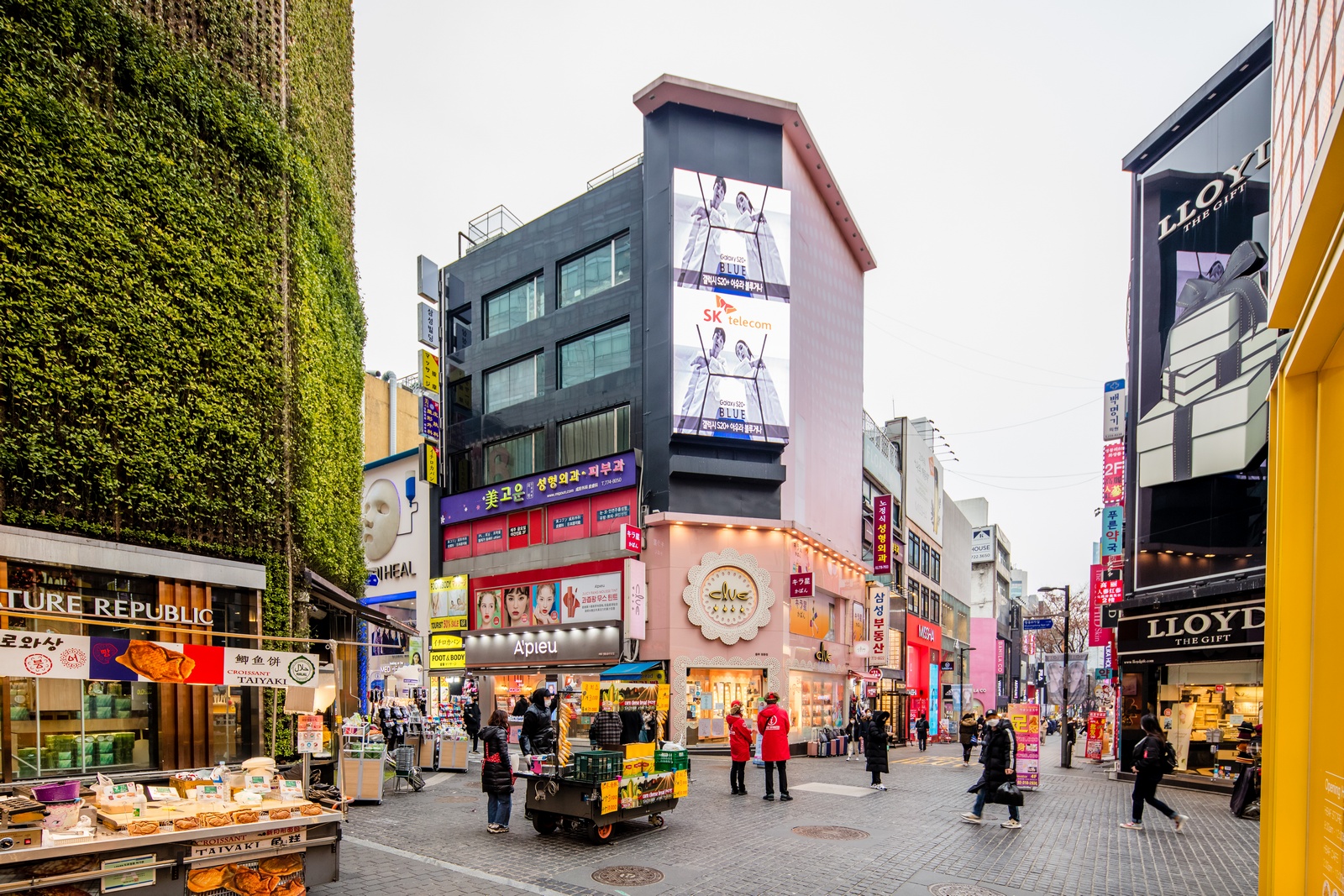
Why I Keep Coming Back to Myeongdong
I have walked through Myeongdong more times than I can count — probably somewhere between 200 and 300 visits over the past fifteen years, depending on whether you count the times I simply cut through it on my way to Namdaemun Market. And yet, every single time I bring a foreign friend here for the first time, I feel something shift in me. I see it again through their eyes. The density of it. The smell of egg bread and grilled skewers drifting out from between cosmetics shops. The way the cathedral suddenly appears at the top of the hill, quiet and stone-grey, completely indifferent to all the commercial noise below it. That contrast never gets old.
Let me be honest with you from the start, because that is the whole point of this blog: Myeongdong is not a hidden gem. It is not off the beaten path. It is, in fact, one of the most heavily trafficked tourist zones in all of Asia, listed in 2023 as the ninth most expensive shopping street in the world. If you come here expecting an untouched slice of authentic local Seoul life, you will be disappointed. But if you come here understanding what it actually is — a layered, historically rich, commercially electric neighborhood that has been at the center of Korean urban life for over a century — then you will leave with a far richer experience than most tourists manage.
I have guided friends here from California, from the Netherlands, from the Philippines, from Singapore. I guided my college friend James here during a particularly brutal August heatwave, and we ended up ducking into a cosmetics shop air-conditioned to approximately freezer temperature just to survive. I guided my friend Amelie from Lyon during the spring Myeongdong Festival, and she cried a little at the cathedral courtyard because the cherry blossoms happened to be dropping petals in a light wind at exactly the right moment. Different seasons, different moods, different angles — and Myeongdong delivered something real every time.
This guide is everything I wish I had been able to hand my friends before they arrived. Not a sanitized brochure version. Not a copy-paste from a travel aggregator. The real version, from someone who has lived here for fifteen years and still takes people here every single month.
A personal note before we begin: The first time I brought a foreign visitor to Myeongdong, I made the rookie guide mistake of starting at the subway exit at noon on a Saturday in July. Within eight minutes, my friend was overwhelmed, sweating, and mildly panicked by the sheer number of people. We retreated, regrouped, and came back the following morning at 10am on a Tuesday. Same neighborhood — completely different experience. Timing, as with so much in Seoul, is everything.
So let’s do this properly. Pull up a map, bookmark this page, and let me walk you through one of Seoul’s most iconic neighborhoods — street by street, era by era, mistake by mistake.
A Quick History (So You Know What You’re Actually Looking At)
Most tourists treat Myeongdong as a backdrop — a place to shop and eat without any particular awareness of what happened on these streets before the skincare brands moved in. I think that is a genuine loss, because this neighborhood’s history is deeply tied to the broader arc of Korean history: colonialism, war, democracy movements, and economic rebirth. Knowing even a little of it transforms the way you look at the buildings and the people around you.
The Joseon Foundation: A Southern Quarter of the Capital
During the Joseon Dynasty, the area now known as Myeongdong went by several names: Myŏngnyebang (명례방), Myŏngnyebanggol, and Chonghyŏn (종현). The name Chonghyŏn is particularly interesting — it referred to a small ridge or hill in the area, and it is on this very ridge that the Myeongdong Cathedral would eventually be built centuries later. The location was not chosen accidentally.
In Joseon-era Seoul, then called Hanseong, this southern quarter was a functional, busy part of the capital. Not the seat of royal power — that was to the north, anchored by Gyeongbokgung Palace — but a lived-in, working part of the city. The groundwork for its future commercial destiny was being quietly laid even then, given its proximity to trade routes and markets that would eventually grow into the Namdaemun area nearby.
Japanese Colonial Renaming and Commercial Expansion
In 1914, during the Japanese colonial period, the neighborhood was renamed Meiji-cho (明治町) — literally “Meiji Town” — after the Japanese Emperor Meiji. This renaming was part of a systematic effort to reshape Korean urban identity through Japanese imperial geography. The streets were restructured, the commercial character of the area intensified significantly, and the influence of neighboring Chungmuro brought Japanese-style commerce flooding into the district.
This is a period of Korean history that carries enormous weight. When you walk through Myeongdong today, the grid of the streets — unusually regular and planned compared to older Korean urban areas — still reflects some of that colonial-era restructuring. The neighborhood did not simply absorb Japanese commerce; it was partly redesigned to accommodate it. For Korean visitors, this history is lived and felt. For foreign tourists, it is worth knowing as context for why the area looks the way it does.
The neighborhood officially reclaimed its Korean identity in 1946, one year after liberation, when it was renamed Myeongdong (명동) — meaning, beautifully, bright neighborhood.
Post-War Boom and the Birth of Modern Myeongdong
After the devastation of the Korean War in the early 1950s, South Korea began its remarkable economic reconstruction. Myeongdong was at the center of this energy. The financial sector — banks, insurance companies, securities firms — expanded from Namdaemun-ro and Euljiro directly into Myeongdong. High-rise buildings went up. Department stores opened. The neighborhood became the address of choice for financial institutions, a status it still holds today. Major names like Citibank, Kookmin Bank, Hana Bank, and HSBC have headquarters or significant presences in Myeongdong, alongside the nearby Bank of Korea.
By the 1970s, Myeongdong had evolved from a financial district into something more culturally electric. Young Koreans — the trendsetting, upwardly mobile generation of Korea’s economic miracle — came here to shop, to be seen, and to define what modern Korean urban style looked like. The area’s identity as a fashion and youth culture hub was born in this decade and has never really left.
Political Demonstrations: The 1980s and 1990s
This is the chapter of Myeongdong’s history that most tourists never learn about, and I think it is one of the most important. Throughout the turbulent decades of Korea’s democracy movement, Myeongdong — and specifically Myeongdong Cathedral — became a focal point for political protest and resistance. The cathedral offered physical sanctuary to demonstrators, and its courtyard and surrounding streets witnessed scenes of enormous historical significance.
Korean democracy was not given — it was fought for, loudly and in the streets, by students, workers, and citizens. Myeongdong was one of the stages on which that fight played out. The cathedral’s role as a place of refuge during these protests is still remembered and respected by older Koreans. If you visit the cathedral and wonder why it carries such a particular weight and gravity, even compared to other historic churches, this history is a significant part of the reason.
For a deeper look at Korea’s cultural heritage sites and their historical significance, the Cultural Heritage Administration of Korea maintains detailed records and context on protected sites including Myeongdong Cathedral.
Tourism Designation and the Modern Era
As of March 2000, Myeongdong was officially designated a Special Tourism Promotion Area by the Seoul Metropolitan Government, and it became a regular stop on the official Seoul City Bus tour. This formalized what was already obvious: Myeongdong had become the single most recognizable tourist destination in Seoul, drawing an estimated two million people a day at its floating population peak. The 2023 ranking as the ninth most expensive shopping street in the world confirms that this commercial energy has only intensified.
The Seoul Metropolitan Government Tourism portal offers current visitor information, event schedules, and area maps if you want to plan your visit around any of the seasonal programs.
What to Actually See and Do (and What to Skip)
Here is where I am going to be more useful than most travel guides, because I am going to tell you not just what exists in Myeongdong, but what is genuinely worth your time as a first or second-time visitor, what is fine but not essential, and what you can honestly skip without missing anything significant.

Myeongdong Cathedral: Go Here First
If you visit Myeongdong and skip the cathedral, you have made a significant error. I say this not because I am particularly religious — I am not — but because Myeongdong Cathedral is one of the genuinely extraordinary buildings in Seoul, and it tells you more about Korean history than almost anything else in the neighborhood.
Built in 1898, it is the oldest Catholic cathedral in Korea. It sits at the top of a hill — the same hill referenced in the old Joseon-era name Chonghyŏn — and its Gothic brick facade creates a visual anchor for the entire area. The contrast between the cathedral and its surroundings is almost cinematic: you are walking through one of the most commercially intense streets in Asia, and then you climb a gentle slope and suddenly you are standing in front of a 19th-century brick cathedral with a quiet courtyard, trees, and the sound of the street fading behind you.
My recommendation: go here in the morning, before 11am, when the streets below are still relatively calm. Sit in the courtyard for a few minutes. Look at the building. Think about the fact that this exact spot has been a sanctuary — literally, physically, a place of refuge — during some of the most difficult moments in modern Korean history. Then walk back down the hill into the chaos of the shopping streets, and I promise the contrast will hit you differently.
The cathedral is open to visitors outside of service times. There is no admission fee to enter the grounds, though as always, I recommend confirming current access details through the Korea Tourism Organization or the cathedral’s own official channels before your visit.
The Main Shopping Streets: Understanding What You’re Walking Into
The main commercial spine of Myeongdong runs in a north-south direction, with dozens of branching alleys filled with shops, street food vendors, and cosmetics outlets. The area covers just under one square kilometer — 0.99 km² officially — which is small enough to explore thoroughly in a few hours, yet dense enough that you could spend an entire day and still find something new.
The shopping here falls into a few clear categories. First, there are the Korean cosmetics and beauty brands — the ones you have already heard about if you have done any K-beauty research. These brands are concentrated in Myeongdong more densely than anywhere else in Korea, and the staff in most of these stores speak enough English and Chinese to help foreign customers. Prices here are comparable to what you would find in Korean duty-free or online, so do not assume you are getting a special deal just because you are buying in person, but the experience of browsing these stores is genuinely fun and the staff are usually enthusiastic about helping you find what works for your skin tone and type.
Second, there are international brand outlets — global fashion and lifestyle brands. These are perfectly fine but not a reason to come specifically to Myeongdong unless you need something specific, since you can find the same stores in most major international cities.
Third, and most importantly for your actual experience, there is the street food ecosystem. The alley vendors in Myeongdong — particularly active from late afternoon through evening — are one of the neighborhood’s real draws. Egg bread (gyeran-ppang), tornado potato skewers, grilled meat skewers, tteokbokki, hotteok, cheese lobster tails, and a rotating cast of seasonal and novelty foods make these alleys worth exploring even if you have zero interest in shopping.
The best meal I have had in Myeongdong cost me almost nothing: I was walking through the alley with my friend Priya from Singapore on a November evening, and we ended up making an entire dinner out of street food — a skewer here, a hotteok there, some tteokbokki from a pojangmacha-style stand. Total cost for both of us was modest, we were completely full, and we had eaten better and more memorably than we would have in any sit-down restaurant in the area. Street food is underrated as a Myeongdong dining strategy.
Myeongdong Theater and Nanta: Live Performance Worth Considering
The Myeongdong Theater is one of the historically significant landmarks of the area, and the Myeongdong Nanta Theater hosts performances of Nanta, a non-verbal Korean percussion comedy show that has been running since 1997 and remains one of Korea’s most popular cultural exports in live performance form. It is genuinely entertaining, completely language-barrier-free, and a solid choice for an evening activity if you want to do something beyond shopping.
I have taken multiple groups of foreign friends to Nanta over the years. It plays well with almost every age and background — the humor is physical, the rhythm is infectious, and the kitchen-based percussion sequences are legitimately impressive. Book tickets in advance, especially during peak tourist seasons, as performances do sell out. Check the official Nanta or KTO booking channels for current pricing and show times.
The Myeongdong Festival: If You Can Time It Right
The Myeongdong Festival has been running since 1982, making it one of Seoul’s longest-running neighborhood events. It happens twice a year: spring (roughly late March to mid-April) and autumn (September). During the festival, the streets host parades, music performances, dance shows, and fashion events. Many shops offer sales and promotions during this period.
If you can time your visit to coincide with the spring festival — particularly if the cherry blossoms are also peaking in late March or early April — you will experience Myeongdong at one of its most atmospheric and photogenic moments. The combination of festival energy, floral backdrop, and (relatively) cooler spring temperatures makes this arguably the best possible window for a Myeongdong visit.
What to Skip (Honest Opinion)
The densest cluster of mid-range tourist restaurants on the main shopping street — the ones with multilingual picture menus and staff beckoning from the doorway — are, in my experience, not worth your time or money. The food is rarely bad, but it is generic and overpriced for what it is. You can eat much better Korean food in the neighborhoods immediately adjacent to Myeongdong. More on that in the day-planning section below.
I would also gently suggest that if you are not specifically interested in luxury or mid-high fashion, the international brand shopping in Myeongdong is not a compelling use of your time in Seoul. There are better shopping experiences elsewhere — more local, more interesting, often cheaper — and Myeongdong’s real value is not in its H&M.
| Attraction | Category | Admission | Best Time to Visit | Notes |
|---|---|---|---|---|
| Myeongdong Cathedral | Historic / Cultural | Free (grounds) | Morning, weekdays | Check service times before visiting |
| Myeongdong Nanta Theater | Live Performance | Paid (check official site) | Evenings | Book in advance during peak season |
| Main Shopping Streets | Shopping / Street Food | Free to browse | Late afternoon–evening for street food | Most crowded on Sat/Sun |
| Myeongdong Festival | Cultural Event | Free (most events) | Late March–April / September | Check Seoul Metropolitan Government site for dates |
| Myeongdong Theater | Arts / Performance | Varies by production | Evenings | Historically significant venue |
How to Get There and When to Go
Getting to Myeongdong is genuinely straightforward. Timing your visit, however, makes an enormous difference to the quality of your experience. Let me break both of these down clearly.
Getting to Myeongdong: Transit Options
The most direct public transit option is Myeongdong Station on Seoul Metro Line 4 (the blue line), which serves the southern part of the neighborhood. This is the station most tourists use, and it drops you directly into the heart of the shopping district. If you are coming from Dongdaemun, Sookmyung Women’s University area, or connecting from Line 1 at Seoul Station, Line 4 is your friend.
The northern part of Myeongdong is more easily accessed from Euljiro 1-ga Station on Line 2 (the green line). If you are coming from Hongdae, Sindorim, or anywhere on the circular Line 2, this may actually be your more convenient option depending on your accommodation location.
Seoul’s subway system is one of the best in the world — clean, punctual, inexpensive, and extensively signed in English. If you have not already loaded a T-money card when you arrive, do so at any convenience store or subway station machine. It works on all subway lines and buses, and the per-ride cost is meaningfully lower than buying individual tickets. You can also use it at many convenience stores, which is genuinely useful.
Walking from nearby neighborhoods is also very viable. From Namdaemun Market, Myeongdong is about a 10-minute walk. From Gwanghwamun or the area around Deoksugung Palace, you can walk south and reach Myeongdong in roughly 15–20 minutes, which is actually a lovely walk past some interesting streets. From Dongdaemun, it is a longer walk — better to take the subway.
| Origin Area | Recommended Route | Approx. Travel Time | Notes |
|---|---|---|---|
| Seoul Station / Itaewon | Line 4 to Myeongdong Station | 5–15 min | Direct, very easy |
| Hongdae / Sinchon | Line 2 to Euljiro 1-ga Station | 20–30 min | Access northern Myeongdong |
| Dongdaemun | Line 4 to Myeongdong Station | 10–15 min | Direct, simple transfer |
| Namdaemun Market | Walk south | ~10 min on foot | Easy, pleasant walk |
| Gwanghwamun / Insadong | Walk south or Line 1/5 + transfer | 15–25 min | Walking route is scenic |
| Incheon Airport (ICN) | AREX to Seoul Station, then Line 4 | ~60–70 min total | Express AREX recommended |
When to Go: Seasons
Spring (late March to May) is my personal top recommendation for a Myeongdong visit. The temperature is comfortable — typically ranging from around 10°C to 20°C — the spring Myeongdong Festival may be running, and if the cherry blossom timing aligns (usually late March to early April), the combination of festival atmosphere and flowering trees is extraordinary. This is when I brought Amelie, and the visit became one of those genuinely memorable travel moments.
Autumn (September to November) is equally beautiful and equally well-timed given the autumn Myeongdong Festival in September. October and November bring clear skies, cooling temperatures, and the rich amber and red foliage that makes Seoul look spectacular. This is also a major holiday period with Chuseok in September or October, so check the specific dates of any national holidays before you go, as some businesses adjust hours.
Summer (June to August) is brutal, particularly July and August. Seoul summers are genuinely hot and humid in a way that many visitors from temperate climates find difficult. Myeongdong, with its dense crowds and canyon-like street layout, traps heat effectively. If you visit in summer, go early in the morning or after dark. Do not, as I once did with James, arrive at noon in August. The streets are also at their most crowded in summer due to the international tourist peak season.
Winter (December to February) is cold — sometimes very cold, with temperatures regularly below freezing — but also genuinely charming. The Christmas and New Year decorations in Myeongdong are elaborate and photogenic, and the street food hits differently when the air is cold (hot egg bread in winter is one of life’s small perfections). Crowds are thinner than in summer or during festivals, which some visitors actually prefer.
When to Go: Time of Day
Weekday mornings — Tuesday through Friday, before 11am — are when Myeongdong is at its most manageable. Most shops open around 10am, the street food vendors are just setting up, and you have a brief window to walk the alleys without significant shoulder-to-shoulder crowding.
Late afternoon through evening (4pm to 9pm) is when the street food scene peaks. This is the recommended window if street food is a priority, even though the crowds are also at their most intense.
Saturday and Sunday midday through evening is the most crowded window of the entire week. It is not unpleasant if you are prepared for it, but if you have any flexibility at all, weekdays are significantly more comfortable.
The main street and most alleys are blocked off from vehicle traffic during normal hours — except for early morning and late-night delivery windows — making the entire area a pedestrian zone in practice. This is genuinely appreciated when you are trying to navigate with a group.
What to Combine It With for a Perfect Day
Myeongdong’s greatest asset as a tourist destination is its central location. It sits in a geographic sweet spot that makes it easy to combine with an enormous range of other Seoul experiences. Here are my tried-and-tested plans for different amounts of time.

Half-Day Plan: Myeongdong + Namdaemun Market
If you only have a morning or afternoon to spare, the most natural pairing is Namdaemun Market, which sits just to the southwest and is walkable in about ten minutes. Namdaemun is one of Korea’s oldest and largest traditional markets, and the contrast with Myeongdong’s gleaming commercial streets is striking and educational. Start at Myeongdong Cathedral first thing in the morning, walk the main shopping alleys briefly, pick up breakfast from a street food vendor, and then walk down to Namdaemun to browse the market stalls before it gets too hot or crowded.
This combination gives you both the modern commercial face of Seoul tourism and a glimpse of how Korean market culture actually works at a more traditional level — the kind of market where locals actually shop for everyday goods, produce, and textiles alongside tourists.
Full-Day Plan: Myeongdong + Bukchon / Insadong + Gwanghwamun
For a genuinely satisfying full day that contextualizes Myeongdong within a broader Seoul narrative, I recommend starting not at Myeongdong but further north, at Gwanghwamun Square and Gyeongbokgung Palace in the morning. Walking through a Joseon-era royal palace before you walk through the streets that were once Joseon-era Myŏngnyebang creates a meaningful through-line in your understanding of the city’s historical geography.
From Gwanghwamun, walk east through Insadong (Seoul’s arts and crafts street, excellent for traditional snacks and independent galleries) and then south through or around Bukchon Hanok Village if you want the traditional architecture experience. By early afternoon, make your way south toward Myeongdong. You will arrive with historical context firmly in place, and the modern commercial energy of Myeongdong will feel like the logical conclusion of a city’s evolution rather than just a shopping district that appeared from nowhere.
Finish the day with Nanta at the Myeongdong Nanta Theater in the evening. You will have covered roughly 1,000 years of Korean history in a single well-planned day. I have done this itinerary with guests many times and it consistently works. Check out our Seoul travel guide section for detailed coverage of Bukchon and Insadong as standalone destinations.
Two-Day Extension: Bringing Myeongdong Into a Larger Seoul Experience
If you have two full days in central Seoul, I would position Myeongdong as your afternoon-evening anchor on Day One, arriving at the cathedral around 3pm, exploring the shopping alleys and street food scene through early evening, and catching a performance if you have booked one. Reserve Day Two for neighborhoods that offer a different register entirely.
On Day Two, I would push south toward Itaewon and Haebangchon for a multi-cultural food experience, or east toward Dongdaemun for the night market and design museum scene. Alternatively, take the subway to Hongdae in the western part of the city for Seoul’s indie music, street performance, and younger creative culture. Each of these neighborhoods tells a completely different story about what Seoul is, and all of them are within 20–30 minutes of Myeongdong by public transit.
A tip I give every group I guide: Do not try to see all of Seoul in one trip. The city is enormous and the neighborhoods are genuinely distinct. Pick three or four areas that match what you care about — history, food, art, nightlife, nature — and go deep rather than skimming the surface of ten places. Myeongdong deserves two to three hours of real attention, not a 45-minute rush between your next tour bus stop.
If you are interested in learning some basic Korean phrases before your trip — which I genuinely recommend and which will be received warmly by locals — visit our Korean language learning section for beginner-friendly guides to pronunciation and essential travel vocabulary.
Honest Mistakes to Avoid
I have watched hundreds of foreign visitors make the same avoidable errors in Myeongdong. None of them are catastrophic — this is a safe, tourist-friendly neighborhood — but they do lead to frustration, wasted money, and missed opportunities. Here is the list I run through with every group I guide.
Mistake 1: Going on Saturday Afternoon
I have addressed this in the timing section, but it bears repeating as a standalone warning because I see it go wrong so consistently. Saturday afternoon in Myeongdong is peak crowd density — not just by Seoul standards but by global urban standards. If you are prone to crowd anxiety, if you are traveling with young children, or if you simply want to actually see the shops rather than be pushed past them in a slow-moving river of humanity, please choose a weekday.
Mistake 2: Eating All Your Meals Inside the Main Shopping District
The sit-down restaurants directly on and immediately adjacent to the main Myeongdong shopping street are, with some exceptions I am sure exist somewhere, not your best dining option in the area. They are priced for tourist convenience and the food quality does not justify the premium over what you can find one or two subway stops away or in the side streets of neighboring areas. Street food for snacking in Myeongdong: excellent idea. Full-service restaurant meals in the commercial core: save that budget for somewhere better.
Mistake 3: Skipping the Cathedral Because It Looks Religious
Even if you have zero interest in Catholicism or religion in general, please do not skip Myeongdong Cathedral. It is not primarily an active religious site from a tourism perspective — it is a genuinely beautiful 19th-century Gothic building with deep historical significance in Korean political and social history. The courtyard alone is worth the five-minute uphill walk. I have never brought a single guest to the cathedral who was not glad they went.
Mistake 4: Assuming Prices Are Negotiable
In many parts of Seoul and Korea, particularly in traditional markets like Namdaemun or Dongdaemun, some price negotiation is possible and culturally normal in specific vendor contexts. In Myeongdong’s branded cosmetics stores and international retail outlets, prices are fixed. Attempting to negotiate in these stores will create awkwardness and is not going to work. If you want to negotiate, save that energy for the traditional market experience.
Mistake 5: Not Having a T-Money Card Loaded Before You Arrive
This is not Myeongdong-specific but it consistently affects the experience of getting there and moving around. The Seoul subway is easy — but only if you have a T-money card or equivalent transit payment ready. You can buy and load these cards at convenience stores near any subway station. Do it at the airport when you land, or at your accommodation area before you set out for Myeongdong. Running out of credit on your card in the middle of navigating a transit transfer adds unnecessary stress to an otherwise straightforward journey.
Mistake 6: Buying Skincare Products Without Knowing Your Skin Type
The K-beauty shopping experience in Myeongdong is genuinely excellent and I am enthusiastic about it — but I have watched friends get swept up in the excitement and buy products that were wrong for their skin type, sometimes the opposite of what they needed. If you plan to invest seriously in K-beauty products in Myeongdong, do a small amount of research beforehand: know whether your skin is oily, dry, combination, or sensitive, and know whether you are looking for brightening, hydration, acne control, or anti-aging solutions. The staff in the major cosmetics stores are knowledgeable and genuinely helpful when you can give them this starting information. Going in blind tends to result in impulse purchases you regret later.
Mistake 7: Not Checking the Myeongdong Festival Dates Before Your Trip
If your trip falls anywhere near late March through April or during September, check whether the Myeongdong Festival is running during your specific dates. If it is, build your schedule around being there during the festival period — the added energy, programming, and shop promotions genuinely enhance the experience. If it is not running, no adjustment needed, but it is worth knowing in advance. Check the Seoul Metropolitan Government Tourism portal or the Korea Tourism Organization’s English site for current event schedules.
Mistake 8: Leaving Before Dark
This applies particularly to first-time visitors who treat Myeongdong as a daytime-only destination. The neighborhood changes character after dark in ways that are worth experiencing. The street food vendors are busiest and most varied. The neon signage of the commercial streets creates a visual atmosphere that is genuinely distinctive. The cathedral, lit up against the evening sky, is beautiful in a different way than it is in morning light. If you arrived in the afternoon, stay through at least early evening before you move on. You will see a meaningfully different version of the same neighborhood.
FAQ
Is Myeongdong safe for tourists?
Yes, extremely. Myeongdong is one of the safest tourist neighborhoods in Seoul, which is already one of the safest major cities in the world. Petty crime is rare, the area is heavily trafficked and well-lit even late at night, and there is a significant tourist police and support infrastructure in place. Solo travelers, including solo female travelers, consistently report feeling safe here. Standard travel common sense applies — keep an eye on your belongings in dense crowds — but there is no specific safety concern that should give you pause about visiting Myeongdong.

Do I need to speak Korean in Myeongdong?
No. Myeongdong is probably the single most tourist-adapted neighborhood in all of Korea from a language perspective. The major cosmetics stores, restaurants, and shops have staff who speak English, often Japanese and Chinese as well. Street signage has English and frequently Chinese and Japanese translations. If you speak no Korean at all, you will navigate Myeongdong without significant difficulty. That said, knowing a few basic phrases — hello, thank you, how much — is always appreciated by locals and often rewarded with warmth and extra helpfulness. Check our Korean language section for beginner-friendly phrase guides.
How much time should I spend in Myeongdong?
For most first-time visitors, two to four hours is the right amount of time to see the cathedral, walk the main streets and alleys, do some shopping or street food browsing, and get a real feel for the neighborhood without reaching the point of sensory overload. If you are adding a Nanta performance in the evening, budget an additional two hours. If you are a serious K-beauty shopper, you could comfortably spend half a day and not exhaust the options in the cosmetics stores alone.
What is the best street food to try in Myeongdong?
The most beloved and uniquely Myeongdong street food experience is gyeran-ppang — egg bread, a warm, slightly sweet dough-based bun baked with a whole egg on top. It is simple, filling, and absolutely delicious in cold weather. Beyond that, tteokbokki (spicy rice cakes in gochujang sauce), tornado potatoes on a skewer, hotteok (sweet filled pancakes), and odeng (fish cake skewers in hot broth) are all reliable, beloved street food options. Do not let anyone pressure you into the novelty lobster or giant crab items at inflated prices — they are a tourist trap and the quality does not match the cost.
Is Myeongdong expensive?
It depends entirely on what you do there. The street food is very affordable — you can eat well for a very modest amount per person. The cosmetics stores span a wide price range, from budget-accessible to premium. The major department stores and branded boutiques are mid-to-high priced by Korean standards and comparable to or higher than what you would pay for the same international brands at home. The neighborhood itself costs nothing to visit — the experience of walking the streets, visiting the cathedral, and soaking in the atmosphere is completely free.
What are the subway stations closest to Myeongdong?
Myeongdong Station (Line 4, Station #424) serves the southern part of the neighborhood and is the most commonly used entry point for tourists. Euljiro 1-ga Station (Line 2, Station #202) serves the northern part of Myeongdong and is useful if you are coming from stations on the green circular Line 2. Both stations have signage in English and are easy to navigate even without prior experience on the Seoul subway.
Is Myeongdong worth visiting if I am not interested in shopping?
Yes, genuinely. The Myeongdong Cathedral alone justifies a visit for anyone interested in architecture, Korean history, or the country’s democracy movement. The street food scene is interesting and delicious independent of any shopping interest. If a Nanta performance is running, it requires no shopping enthusiasm whatsoever. And the sheer experience of being in one of Asia’s most intense commercial districts — understanding it, observing it, feeling its energy — has value as a cultural experience even if you buy nothing at all.
Can I visit Myeongdong Cathedral even if I am not Catholic?
Absolutely. The cathedral grounds are open to respectful visitors of all faiths and none. The courtyard is a public space and the building itself can be entered outside of mass and service times. Please be respectful of the space — it is an active place of worship — but there is no requirement of religious affiliation to visit. The cathedral is listed among Korea’s significant cultural and historical sites, and the Cultural Heritage Administration provides additional historical context about its significance.
When is Myeongdong least crowded?
Weekday mornings between 10am and noon are the quietest window within normal visiting hours. Early January and late February (deep winter, after the New Year holiday period) also tend to bring thinner crowds than any other time of year. If you want a more relaxed version of Myeongdong, this is your window — though you will trade crowd density for colder temperatures.
Are there ATMs in Myeongdong?
Yes, numerous. Myeongdong is home to several major bank headquarters and branches, meaning ATM access is genuinely excellent here compared to many other tourist neighborhoods. Post Office ATMs and banks with international transaction capability (Citibank, HSBC, and Korean major banks) are all present. Most convenience stores (CU, GS25, 7-Eleven) also have ATMs that accept foreign cards, and there are multiple such stores throughout the neighborhood. Cards are also widely accepted in most shops and restaurants, though some smaller street food vendors are cash-preferred.
Is Myeongdong accessible for visitors with mobility limitations?
The main pedestrian streets of Myeongdong are flat and wide, making them relatively accessible. The access to Myeongdong Cathedral involves a gentle uphill slope, which may require some consideration. Both Myeongdong Station and Euljiro 1-ga Station have elevator access. Seoul’s subway system overall has improved significantly in accessibility infrastructure in recent years, though some older station exits still have stairs without elevator alternatives — check the specific exit before your visit if this is a concern.
Does Myeongdong have a lost-and-found or tourist assistance service?
Yes. As a designated Special Tourism Promotion Area, Myeongdong has tourist assistance infrastructure including information booths staffed by volunteers who speak English and other languages. These are typically located near the main subway exit and at key intersections in the shopping district. Seoul’s broader tourist assistance services, including the 1330 Korea Travel Helpline (available in English, Japanese, and Chinese), are also available for any more serious assistance needs.
Final Thoughts from a Local
Here is what I want you to take away from this guide, beyond all the practical logistics: Myeongdong rewards the curious visitor and slightly frustrates the passive one. If you show up with no plan, go where the largest crowd is heading, eat in the first restaurant with an English menu, buy things because you are overstimulated, and leave without going to the cathedral — you will have had a broadly fine but completely forgettable experience. That would be a shame.
But if you go in knowing even a fraction of the history — the Joseon ridge, the colonial renaming, the post-war financial boom, the democracy protests in the cathedral courtyard, the decades of youth culture and commercial evolution — then every corner of Myeongdong starts telling you something. The contrast between the Gothic brick and the K-beauty signage is not accidental or arbitrary. It is the story of Korea in concentrated form: ancient, disrupted, rebuilt, globally connected, and deeply itself all at once.
What I always tell my friends before we go: Walk slowly. Look up from your phone. Eat something from a street vendor before you go into a single shop. And go to the cathedral first — always go to the cathedral first.
I will be walking through Myeongdong again next month with someone new. And the month after that. And if you make it to Seoul, drop a comment below or reach out through the contact page. I might just see you there, walking up the hill toward the cathedral at 10am on a Tuesday, doing it exactly right.
Safe travels, and see you in Seoul. — Your local guide at KRGuide.com
Sources and further reading: Korea Tourism Organization (KTO) | Seoul Metropolitan Government Tourism | Cultural Heritage Administration of Korea | Wikipedia: Myeong-dong article (factual reference)