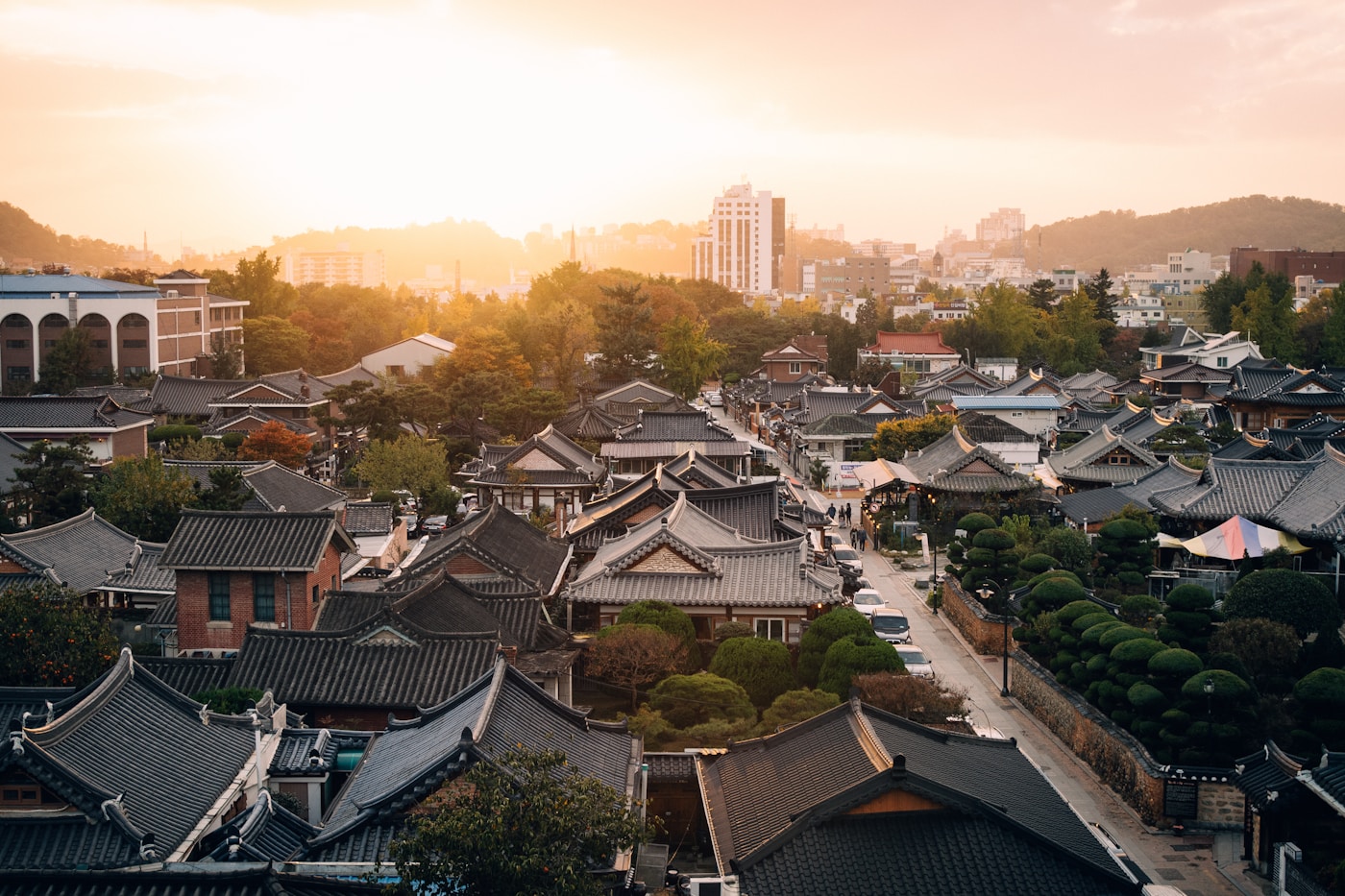
Bukchon Hanok Village — Seoul’s Most Beautiful Traditional Neighborhood — hit me like a quiet thunderclap the first time I rounded the corner of Gahoe-dong and suddenly the entire modern city fell away, replaced by a sea of curved dark-grey tiled rooftops rolling down toward Gyeongbokgung Palace in the distance. After more than a decade of living in Seoul, that view still stops me cold every single time. This is not a reconstructed theme park or a prettied-up tourist set — real families have lived in many of these hanok for generations, and that lived-in humanity is exactly what makes Bukchon feel so different from anywhere else in this city of ten million people.
Wedged between the grand palaces of Gyeongbokgung and Changdeokgung, with Inwangsan Mountain as its rugged northern backdrop, Bukchon occupies one of the most coveted plots of land in all of Korea. The neighborhood’s name literally means “North Village,” and for the Joseon Dynasty aristocracy — the yangban class — living here was the ultimate status symbol. Today, roughly 900 traditional hanok homes remain standing across the hillside lanes of Gahoe-dong, Samcheong-dong, and Wonseo-dong, making this one of the largest surviving clusters of traditional Korean architecture in an urban setting anywhere in the world. Walking these alleyways is not sightseeing — it is time travel with excellent coffee at the bottom of the hill.
How to Get There and When to Arrive
Getting to Bukchon Hanok Village is refreshingly straightforward. Take Seoul Metro Line 3 (the Orange Line) to Anguk Station and use Exit 2 — you will emerge right at the southern gateway of the neighborhood, with Changdeokgung Palace to your left and the uphill lane toward Gahoe-dong stretching ahead of you. Alternatively, Line 3’s Gyeongbokgung Station (Exit 5) puts you at the western edge and makes for a beautiful approach walking east past the palace wall. The walk from Anguk Exit 2 to the famous “Bukchon 8 Gyeongjeom” — the eight scenic viewpoints signposted throughout the village — takes about 40 minutes at a relaxed stroll if you don’t stop, which you absolutely will.
Timing your visit is everything here. I cannot stress this enough: arrive before 9:00 AM. The narrow lane at Gahoe-dong Alley No. 11, which is the most photographed street in the entire neighborhood — the one where the hanok rooftops cascade downhill with N Seoul Tower peeking above them in the distance — becomes genuinely shoulder-to-shoulder packed by 10:30 AM on weekends. Weekday mornings between 7:30 and 9:00 AM are magical; you’ll hear nothing but the wind, distant temple bells from Jogyesa, and the occasional resident shuffling to the corner store in slippers. Autumn (late October to mid-November) delivers fiery maple trees draped over the clay-tiled walls, while early March brings delicate plum blossoms to the inner courtyards — both seasons make Bukchon look almost painfully beautiful.
The single best-kept secret in Bukchon is the rooftop view from the small public rest area just past Viewpoint No. 5 on Gahoe-dong. Most visitors snap their photo at the designated viewpoint sign and immediately turn back down. But if you continue uphill another 60 meters, there is an unlabeled stone bench terrace on the left that gives you a wider, completely unobstructed panorama of the hanok rooftops AND the Namsan Tower simultaneously — and almost nobody ever makes it up there. Go early, bring a coffee from the Café Onion Anguk branch just 200m south (open from 8:00 AM, Americano ₩5,500 / ~$4), and you will have one of Seoul’s great quiet moments entirely to yourself.
What to See, Do, and Experience Inside the Village
The core of Bukchon Hanok Village is best explored through the eight official scenic viewpoints, each numbered and marked with small signboards in Korean, English, and Chinese. Viewpoint No. 2 gives you the sweeping “postcard shot” of the descending alleyway — this is the one you’ve seen on every Korea tourism poster. But honestly, I find Viewpoints No. 6 and No. 7 far more rewarding; they sit higher on the hill in the quieter Wonseo-dong section, where the lanes are narrower, the walls are draped in climbing ivy, and you are deep enough into the residential core that you start seeing real domestic life — laundry hanging over courtyard walls, potted chrysanthemums lined up on doorsteps, elderly neighbors chatting on low wooden benches.
Privacy Policy | Terms of Use | Contact