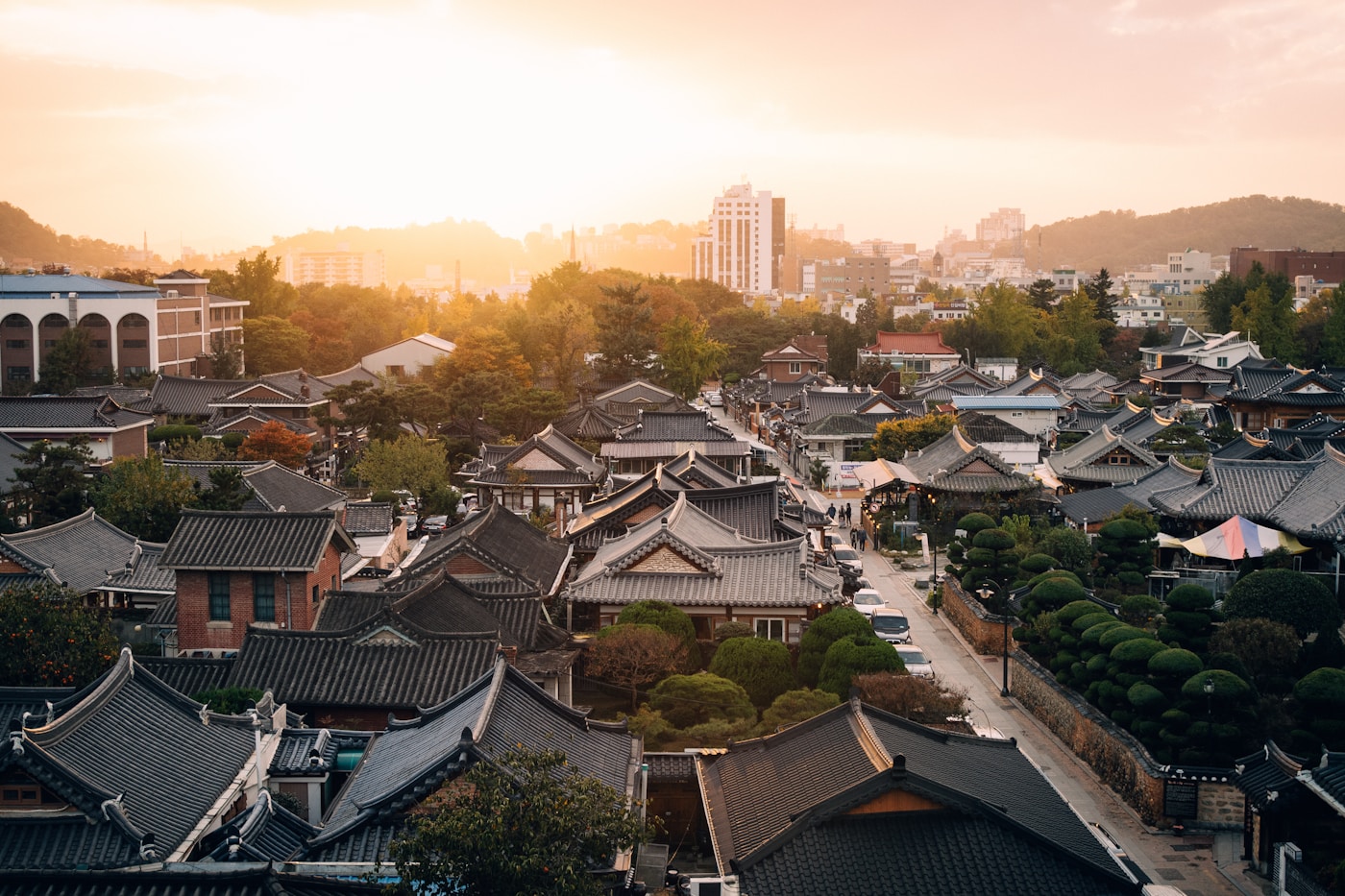
Bukchon Hanok Village — Seoul’s Most Beautiful Traditional Neighborhood — is one of those rare places that genuinely stops you mid-step, and I still get that catch in my chest every single time I walk up Gahoe-ro 11-gil on a crisp autumn morning, the curved black-tiled rooftops rippling down the hillside like a brushstroke painting come to life. Tucked between Gyeongbokgung Palace and Changdeokgung Palace in the heart of Jongno-gu, this living, breathing neighborhood has somehow held its ground against 600 years of history, Japanese colonial rule, rapid modernization, and the relentless march of Seoul’s skyline — and it remains, without question, the single most cinematic stretch of traditional Korean architecture you will find anywhere inside a major Asian capital city.
What makes Bukchon genuinely different from other heritage districts across Asia is that real families still live here. These are not museum reconstructions or theme-park replicas — they are private homes, and the 900-plus hanok houses lining the steep alleyways have been continuously inhabited and maintained for generations. When the light turns golden around 5 p.m. in October and the scent of someone’s dinner drifts over a low earthen wall, you will understand immediately why this neighborhood makes every “most beautiful places in Korea” list ever written, and why it deserves every word of that praise.
How to Get There, When to Visit, and What to Expect
Getting to Bukchon Hanok Village is genuinely easy — take Subway Line 3 (the orange line) to Anguk Station and use Exit 3. From the exit, you will walk about five minutes north up Bukchon-ro toward the main village entrance. Alternatively, Line 3 Gyeongbokgung Station (Exit 2) gives you a slightly longer but beautifully scenic approach past the palace walls. I personally prefer the Anguk approach because you pass a row of small traditional tea shops and independent bookstores on Insadong-gil before the neighborhood reveals itself gradually — and that slow reveal is part of the magic. Avoid taking a taxi directly into the lanes; the streets are absurdly narrow and drivers hate the detour.
For timing, I will be honest with you: Bukchon is genuinely crowded on weekends between 10 a.m. and 4 p.m., especially in spring (late March through April, cherry blossoms) and autumn (mid-October through early November, golden foliage against the grey tile roofs). If you want that iconic, nearly empty alley photograph — the one with the long staircase of Gahoe-ro 11-gil — you need to be standing there no later than 7:30 a.m. on a weekday. I have done it dozens of times and the village at dawn, with soft mist rolling off Bugaksan mountain behind you and not another tourist in sight, is genuinely one of Seoul’s great quiet gifts.
The eight official “Bukchon Scenic Points” are well-marked, but locals know that Scenic Point 2 — the mid-staircase viewpoint on Gahoe-ro 11-gil — is far more spectacular photographed from above, not below. Walk all the way to the top of the lane, turn around, and shoot back downhill with the Han River faintly visible on the horizon on clear winter days. Also: the tiny path that runs along the north wall of Changdeokgung Palace (Waryong Park trail) is almost never mentioned in guidebooks, yet it offers a rooftop-level view over the entire hanok sea that will absolutely wreck you with its beauty.
What to Do, See, and Experience Inside the Village
Walking is the entire point of Bukchon Hanok Village, and I mean that with complete sincerity — put your phone in your pocket for at least thirty minutes and simply wander. The official self-guided walking route covers eight scenic viewpoints and takes roughly ninety minutes at a relaxed pace. Start at Bukchon Traditional Culture Center on Gyedong-gil (free entry, open Tuesday–Sunday 9 a.m.–6 p.m.), where you can pick up a free Korean–English map and occasionally catch a free gayageum or pansori performance in the inner courtyard. These performances are not widely advertised — I stumbled onto my first one purely by accident — and sitting cross-legged on a wooden maru (elevated porch floor) listening to traditional music with hanok rooftops all around you is as close to time travel as Seoul offers.
For hands-on cultural experiences, Bukchon has excellent options at very reasonable prices. Gahoe Minhwa Workshop on Gahoe-ro 11-gil offers minhwa (traditional folk painting) classes starting at ₩20,000 (~$15) per person, no reservation needed on week